Progress Illusion
Momentum Gap
Thriveherd blog
Get practical insight on career change, confidence and purposeful work.
Short, thoughtful emails without noise. Unsubscribe anytime.
There’s a tricky point in any career stretch – whether we’re talking about changing direction, evolving where you are, or pushing for growth – where things start to wobble a bit.
And the thing is, that wobble doesn’t follow a neat timeline.
Sometimes it’s the post-start dip – right after the relief of finally doing something. You’ve updated the CV, signed up for the course, had the conversation, told people you’re making a move. After months (sometimes years) of stress and tension, any kind of movement feels like progress.
Our members have said the same thing – that first step can feel almost euphoric. Like, “Right. I’ve done it! I’m in motion.”
Trouble is, sometimes that initial surge creates the illusion of success. You’re no longer stuck, and that alone feels like a win.
Other times, the wobble comes further along in the journey. The novelty has worn off, you’re still showing up, still doing the work... but the results haven’t caught up yet.
And occasionally – which feels particularly unfair (!) – it shows up right when you’re on the verge of something good. The opportunity is closer, the stakes feel higher. And the fear is real.
But look – whenever the wobble arrives, the experience is similar.
You’re doing the work, investing time and energy. But externally? Nothing dramatic has shifted and it feels like "it's not working".
And you start to think things like, "It's not working," or, *"*Maybe this isn’t going anywhere".
As most of us know, this wobbly dip we're talking about can feel worse than the original frustration that made you start.
But here’s what’s important: that wobble isn’t proof you were wrong to begin. It’s very often the natural and understandable drop after the emotional high of action – or the plateau before compounding kicks in.
It’s the middle – and the middle is where the battle is really won or lost. So get ready for your training...
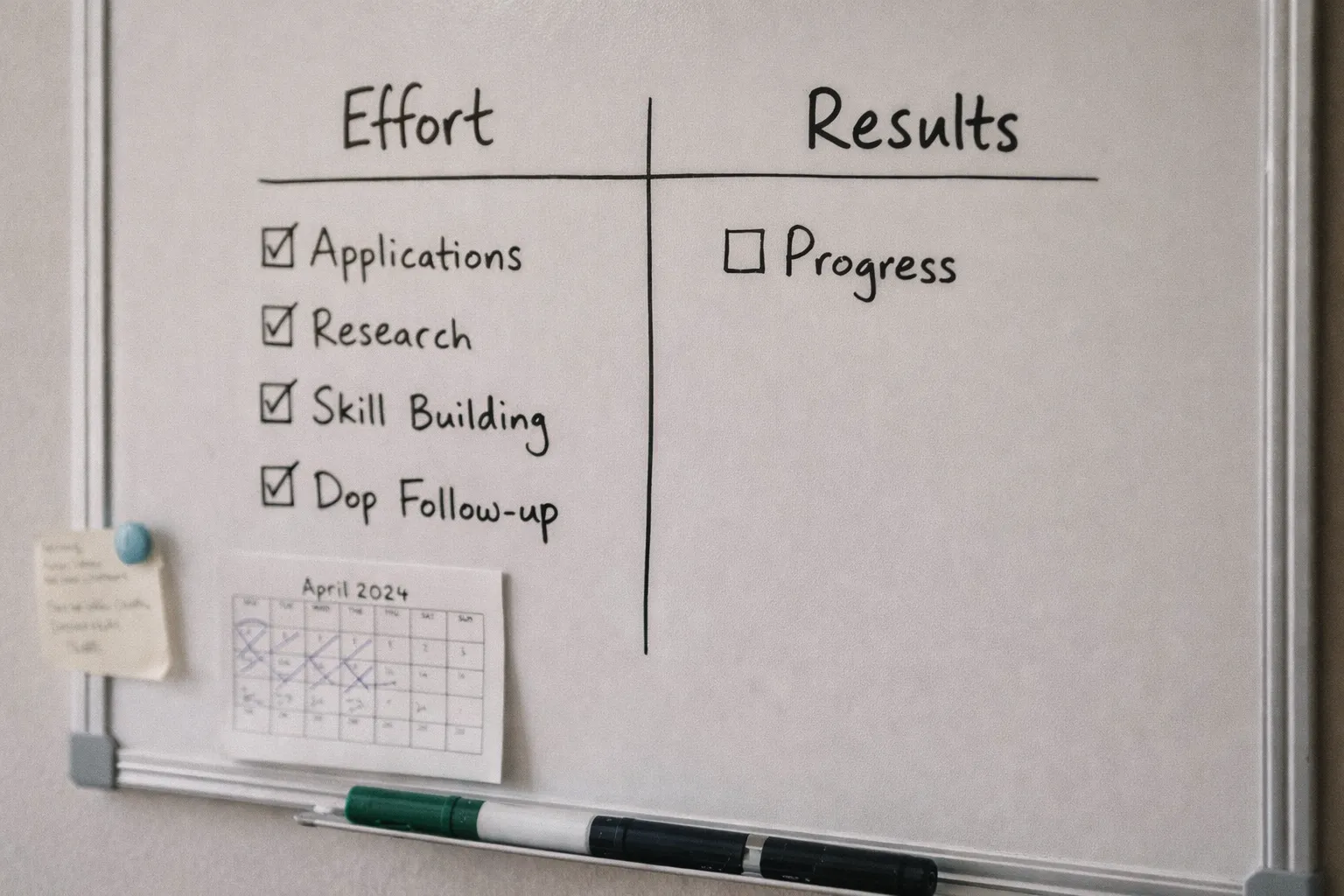
We see it all the time at Thriveherd: one of the hardest things about career change or growth is that effort and visible reward rarely move in sync.
You’re putting in:
... but the external world doesn’t immediately respond.
That gap between effort and outcome can be really uncomfortable. We all know this to be true from experience: it messes with your confidence. It makes you question your judgement.
Most meaningful career progress starts to happen before it’s obvious.
You’re building things that don’t show up on a dashboard:
The reality is, none of that produces instant applause. Much as we'd like it to!

By the time the external shift happens – the offer, the opportunity, the recognition – the foundation has often been forming for ages – months, or even years.
So when progress feels slow, it’s worth asking: is nothing happening… or is something foundational happening that just isn’t visible yet?
Even being passionate about a direction doesn't guarantee motivation. Many people hit this phase when they're trying to change career to find meaningful work — and that transition can create new pressures around the work itself. We explore this more deeply in Does doing what you love for work ruin it?
Remember: slow doesn’t automatically mean stagnant. Sometimes it means structural – and end-stage outcomes aren't the only measures of success.
If we’re honest, most of us underestimate how messy growth will feel.
We imagine clarity arriving quickly – like stepping into a clearing. We assume that once we commit, momentum will feel reliable and steady (or tracking up). We think effort will translate into visible progress in a fairly linear way.
And then reality shows up, with its ambiguity, its silence, its setbacks. Your energy dips.
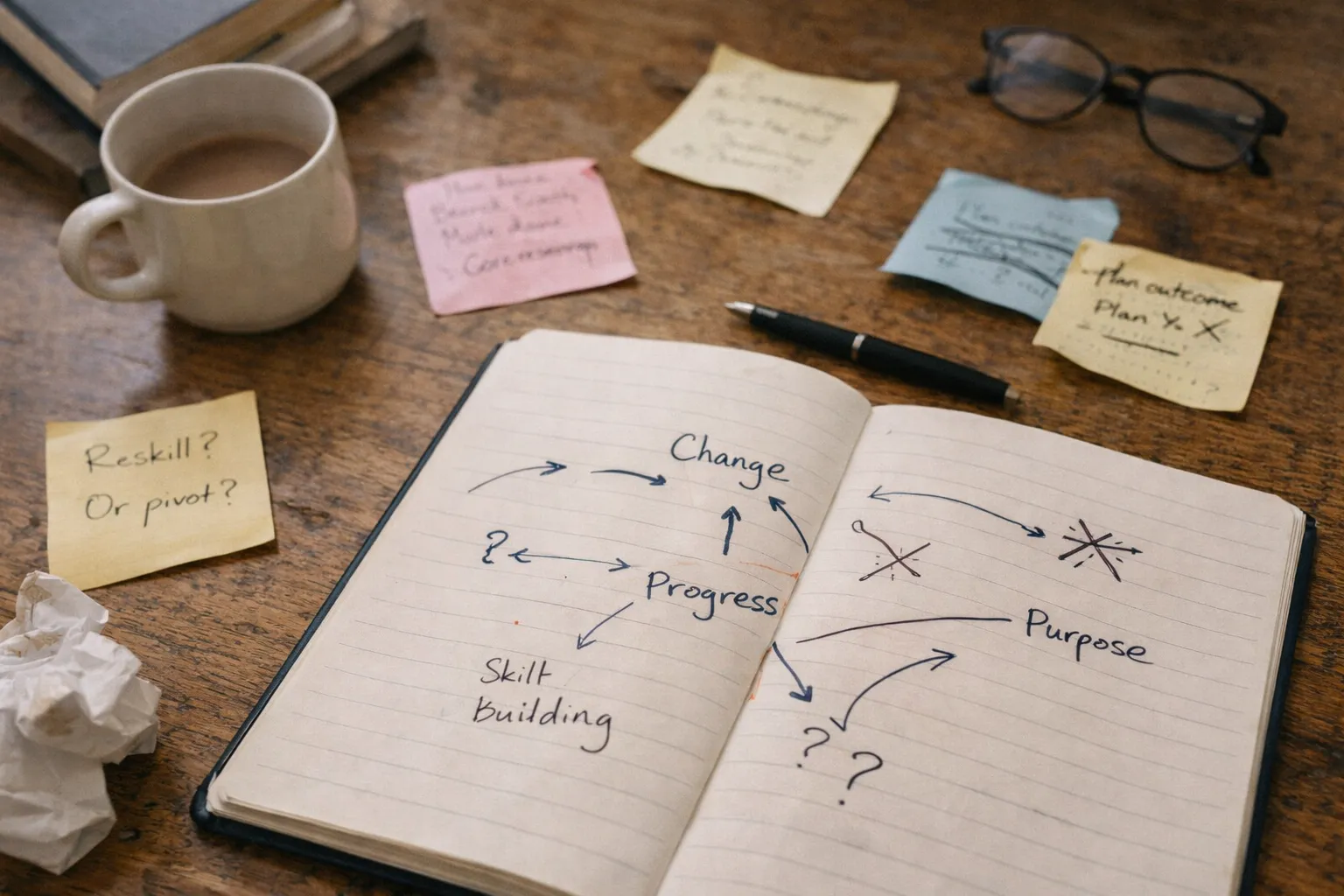
But the discouragement often isn’t just about slow progress. It’s about the mismatch between what we expected and what transition actually feels like.
Career change, growth, stretching into something new – they're very rarely clean. They're iterative and uneven. Success is found not in whether you strike gold first time, but in how you learn and adjust as you go.
If you expected instant confirmation, every wobble feels like a warning sign.
If you expect experimentation, wobble becomes part of the process.
Applications get ignored or quickly binned. Conversations don’t convert. Ideas don’t land. Energy waxes and wanes. Burnout is a possibility, especially if you're a deep thinker or care a lot. This is the reality.
Thing is, setbacks are not evidence that you’re incapable. They’re part of iteration.
What separates people who eventually build momentum from those who drift away isn’t certainty or constant confidence. It’s how they recover. It's how they say, "OK, this isn't ideal but it's a learning point. Next, I'll..."
Do you treat a setback as a verdict?
Or as information?
That decision – often made internally or even subconsciously – shapes everything that follows. So bring it out into open conversation.
Sometimes, progress can feel slow not because nothing is happening, but because it isn’t visible to the people who matter. We often do our best work and it never seems to go anywhere, or the right people don't notice. Understanding why you’re not getting noticed at work can change how you approach this, and lead to huge boosts in progress.
We tend to celebrate the leap and the success story.
But most of real growth happens in a much less cinematic space.
You’re showing up, you’re trying, you’re adjusting... You’re not getting applause.
But hey, it’s not catastrophic, and it's not a failure. It’s just mixed, and slow.
And because it’s slow, it’s easy to drift.
This is the messy middle: not dramatic, not glamorous. Just sustained effort without immediate validation.
But this is exactly where momentum (and continuation) is decided.
Not by pretending it’s easy or forcing positivity, that's for sure.
But by adding structure and perspective.
As we established above, if you only measure outcomes, you’ll constantly feel behind.
Outcomes are slow and external. Behaviours, on the other hand, are immediate and yours.
So track things like:

Even if progress feels slow, if you have behavioural evidence like the ideas above, you'll know you're making progress. It gives you something solid to stand on.
Instead of asking, “Has it worked yet?” you can ask, “Did I show up this week? Have I actually done something that could contribute to my future? Or did I just sit and worry?"
That shift matters.
The moment something doesn’t work, your brain will try to turn it into a story about you.
“This means I’m not cut out for this.”
“This proves I misjudged it.”
Interrupt that negative storytelling early.
Ask instead: “What is this showing me?”
Reframing isn’t about denial or fantasy. It’s about keeping the experience in proportion and helping you help yourself.
Look at it this way: if you expect instant success, setbacks will feel crushing. If you expect trial, error and refinement, setbacks become a normal part of momentum.
Long-term goals are harder to achieve. That's not a new idea – it's been around for years (in models like SMART / SMARTER / OKR / FAST / PACT, WOOP...).
The further away something is, the more likely it is to get overwhelming or too big and slippery to handle.
Which isn't to say you can't have longer-term goals. But don’t live exclusively in the long term – chunk them up.
To start with, come back to this week.
Did you:
Four weeks of regular, imperfect action will do more for momentum than months of over-analysis.
Accountability is great. It's powerful because it keeps you acting. And if you don't act, nothing gets done.
But it's not the only kind of support you need. Emotional support keeps you steady.
And they’re definitely not the same thing...

You need people who can say:
You don’t need them to fix it. Just being there and witnessing your experience counts for a lot.
Trying to carry a long transition entirely on your own easily magnifies every wobble. But a shared perspective lightens it.
Many of us can be very "all or nothing" personalities, especially when the stakes are high. When all your emotional energy is invested in a single outcome or worry, every bump or delay feels catastrophic.
Equally, as most of us know, life feels more manageable when it has multiple sources of pleasure and meaning.
So keep investing in:
Joy and growth don’t have to come from one place.
When your career plans or transition are part of your life – not the whole of it – you’ll have far more emotional stamina.
Back to expectations… because they really do shape how we interpret what’s happening.
Most of us start out thinking momentum is simple. You either have it or you don’t, right?!
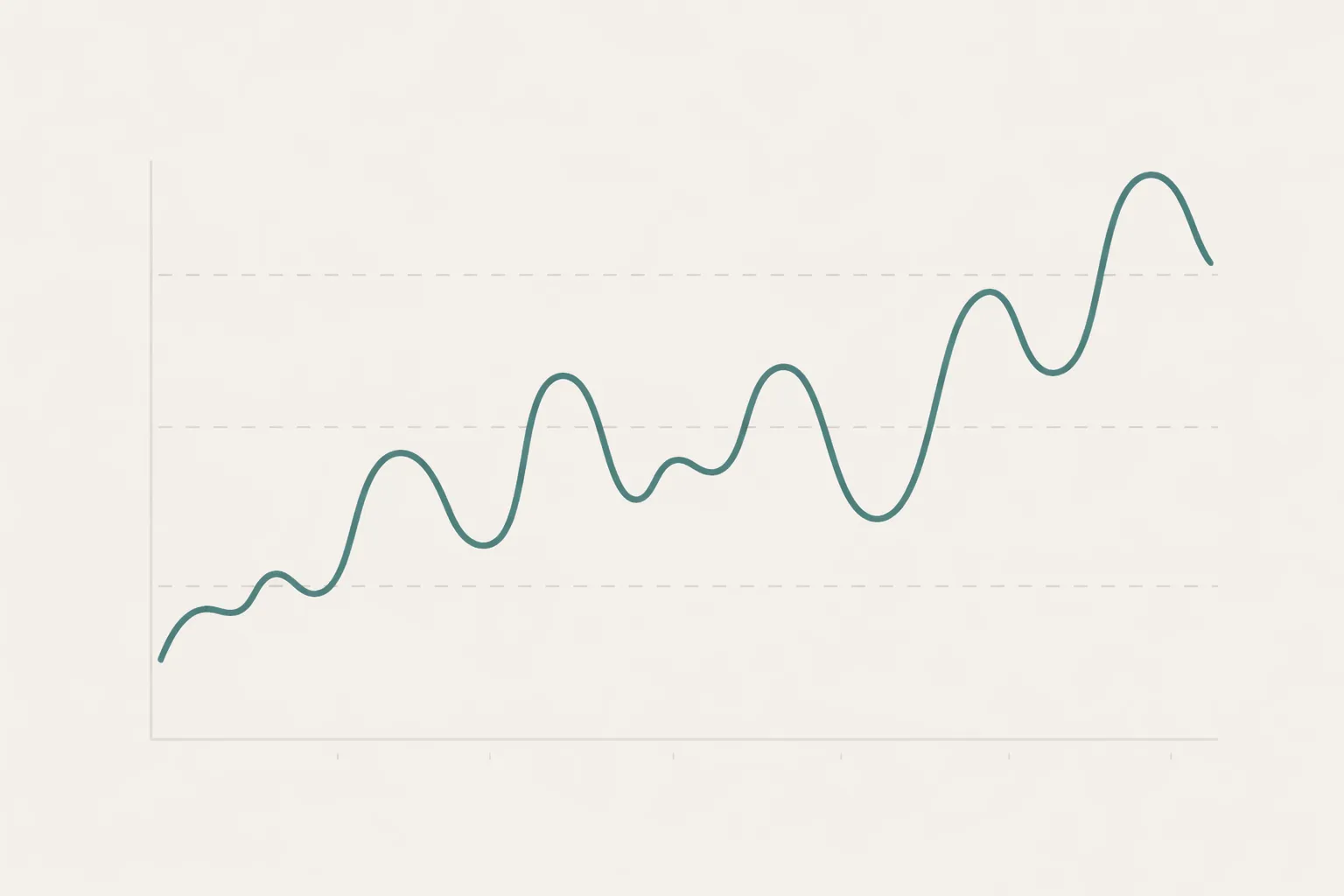
We often think of momentum as a steady forward push. If things are working, they should keep building. If they slow down, something must be wrong. But in reality, momentum is far more unpredictable than that. It speeds up, it slows down, it disappears for a while. It may even come back in a different form.
Sometimes you’ll feel like you’re gathering pace — conversations flowing, ideas landing, confidence rising – but then, without warning, it goes quiet again. Other times, you’ll think nothing is happening… and then something shifts suddenly and things look a lot brighter.
We’ve all seen how breakthroughs can look sudden from the outside. But from the inside, they’re usually built on uneven, stop‑start effort. Not a straight line or slow‑then‑fast. Just variable, simple as that.
The truth is, you can’t always tell what phase you’re in. You might be about to accelerate. You might dip again or need to adjust direction slightly.
So instead of expecting a neat curve, it’s often healthier (and realistic) to expect fluctuation. Think of it as the Stoic's approach to career movement – not necessarily expect the worst, but don't expect it to be easy.
Because when you understand that variability, a slowdown stops feeling like a reason to quit — and starts feeling like a normal part of the rhythm.
There’s an important distinction here.
Slow progress looks like:
No progress looks like disengagement.
If you’re still showing up, learning, adjusting and reflecting – you’re not stuck.
You’re building.
And building, especially in your career, takes time.
##Wrap-up
Progress feeling slow does not mean your goal is wrong or you're going about it wrong. It usually means you’re in the stretch that needs you to be steady and keep things moving forward.
The real question isn’t whether it feels smooth.
A better question is whether you’re willing to stay long enough to keep adjusting, learning and showing up — even when the emotional high has worn off. Is this goal worth a bumpy journey?
Because a bumpy journey is probably your route to success. And you’re further along than you think.
If you’re reading this and thinking, "Yes… but I still feel a bit flat," then don’t just nod along. Reset deliberately.
We don't mean dramatically or with some grand reinvention. Just with decent structure.
Week 1 – Re‑clarify the Direction
Ask yourself: what am I actually trying to move towards right now? Has anything shifted at all? Does this still feel aligned? Strip it back to something simple and clear.
Week 2 – Define the Behaviours
Forget outcomes for a moment. What actions will I take each and every week regardless of results? Applications? Conversations? Practice? Experiments? Make them specific and realistic and hey – you know yourself – something you're actually likely to do.
Week 3 – Increase Visibility Just a Little
Momentum often hides or fades when we stay too private. So share something: reach out, publish a post, start one new conversation. Don’t overhaul everything — just widen your workspace.
Week 4 – Review and Adjust
What worked? What didn’t? What felt energising? What drained you? Adjust based on evidence, not emotion, and say, "So next I'll..."
Four slow and steady weeks won’t transform everything overnight. But they will rebuild rhythm – and rhythm is often what brings momentum back into view.
Because effort and tangible reward don’t move at the same speed. Much of career growth happens internally (in skill, clarity and confidence) before it shows up externally. You've got to be in it to win it – and that often means investing in action before things start to pay off.
Look at the data. Are you learning? Adjusting? Improving your approach? If yes, you may be in a slow phase rather than on the wrong path. If you’re completely disengaged or repeating the same actions without reflection, it might be time to tweak the strategy.
Yes! The relief of starting can create a short emotional high. When that fades and results don’t immediately follow, it can feel like you’ve regressed — but often you’ve simply moved from excitement into the real work.
There’s no fixed timeline. Momentum is variable. It can speed up, slow down or shift form. What matters more than timing is whether you’re staying engaged, taking some form of regular, relevant action, and adjusting as you go. If you're in analysis paralysis or just sitting and worrying, it's time to shake things up. Working with a career coach can significantly accelerate your progress.
That’s not a sign of weakness. It’s often a sign you need support, rest, or a structured reset — not total abandonment. Check your energy, widen your sources of joy, and simplify the next step. Sometimes a rest can be the right action to take.
Follow us on social media:






%20(1).jpg)