Thoughtful Permanence
Under-Stimulation Burnout
Work-Related Rumination
Work Misalignment
Frustrated Conscientiousness
Thoughtful Worker

Thriveherd blog
Get practical insight on career change, confidence and purposeful work.
Short, thoughtful emails without noise. Unsubscribe anytime.
When people talk about burnout at work, the most common explanation is workload.
Too many hours, too much pressure – and often, no time to recover.
And sometimes that explanation is absolutely right. Sustained overload and constant time pressure can lead to burnout even in otherwise healthy environments. This article is not denying that.
But for many, workload alone does not explain everything.
Many of us have seen people handle intense pressure remarkably well when other conditions are positive – when the work feels meaningful, when leadership is supportive, when effort leads to visible impact. There is a big difference between destructive stress and positive pressure.
At the same time, people often burn out even when their workload is not unusually high. And this is a much less discussed problem.

After speaking with hundreds of professionals considering leaving their roles and making a career change, we at Thriveherd began noticing a distinctive pattern.
The people struggling most were rarely disengaged, careless, or underperforming. Actually, they were the most thoughtful ones.
These reflective workers tend to care deeply about:
In conversations about why people consider leaving their jobs, the reasons aren’t usually dramatic. They are rarely about prestige, status, or sudden reinvention. Nor are they just about pressure.
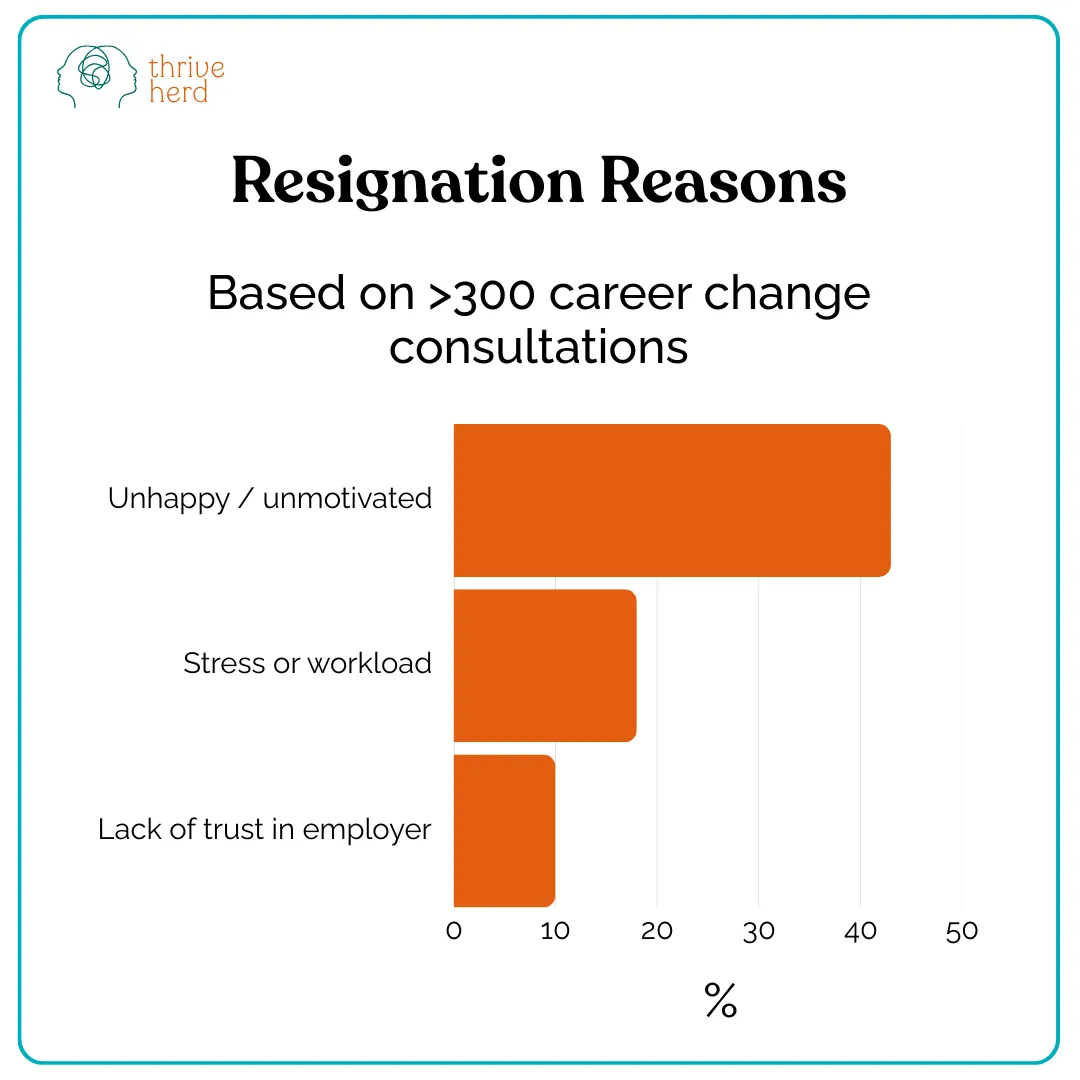
Instead, the same themes crop up time and time again: misalignment with the role, growing demotivation, and a gradual loss of meaning and purpose in the work – often made worse by a lack of support to do good work, declining trust in the organisation, and yes, sometimes stress as well.
But there is another factor that is often overlooked.
Reflective workers sometimes burn out not only from pressure, but from prolonged under‑stimulation – the sense that their abilities, judgement, or attention are being wasted.
For conscientious and reflective people, boredom can be surprisingly corrosive. When someone wants to do meaningful work but finds themselves chronically under‑challenged or unable to use their abilities, motivation often erodes first – and wellbeing soon follows.
In other words, most people near burnout aren't trying to escape work altogether. They might need a pause or a rest – but ultimately, they're trying to find a way of working that is sustainable, stimulating, and aligned with who they are.
And what becomes clear very quickly is that the people most troubled by these tensions are often those paying the closest attention to them.
The same qualities that make someone conscientious, reflective, and responsible can also make modern work environments harder to navigate.
Some things about work have moved on since the twentieth century. Other things haven't.
In many ways, modern workers have changed faster than modern workplaces. But the picture is more complicated than that. Sometimes institutions lag behind new expectations about work, and sometimes – if we're honest – we as individuals can still carry older (or inherited) assumptions about what work should look like.
The result is that people, organisations, and cultures often evolve at different speeds, leaving them out of sync with one another. This mismatch helps explain why many reflective people increasingly experience tension between what work is supposed to be and what it actually feels like.

Historically, many organisations were built around workers expected to perform defined roles, follow established procedures, and remain loyal and stable.
But social trends have changed. Modern societies produce individuals who are:
Philosophers such as Nietzsche and Kierkegaard anticipated this shift long before modern workplaces existed. As individuals become more reflective about how they live, they inevitably begin questioning how they work.
This produces a different type of worker: the thoughtful worker.
Deep thinkers tend to examine questions that previous generations might have ignored:
While this awareness can be a strength, it can also create tension within organisational structures that were never designed for this kind of reflection.
Reflective workers often experience burnout for reasons that go beyond workload and hours.
Two of the most important – and most overlooked – are caring and reflecting.
Because they care about doing good work, many reflective people tend to notice (and feel) – things that others can more easily overlook.
They notice when something is off, like:
But as we all know, awareness alone is not the whole story.
People who think deeply about their work also tend to take responsibility very seriously. When problems appear, they often try to compensate for them personally – by thinking harder, trying harder, or carrying more of the emotional load of the work.
Consider this, too: many thoughtful people can also burn out because their work isn’t fully recognised or understood. If that’s familiar, it’s worth understanding why you’re not getting noticed at work, even when you’re doing everything right.

They care not just about having a job, but about doing that job well. We’re not talking about “work ethic” – there’s enough baggage in that term for an entire article (watch this space!). Simply a sense that “doing this well matters”.
Over time, this can create a form of strain that has little to do with workload and everything to do with what we might call frustrated conscientiousness – the experience of wanting to do good work but being blocked from doing so.
Many reflective people also tend to think deeply on their work and their lives.
They think about:
This reflection can be incredibly valuable.
But it also has a cost. It can be exhausting to have a mind that’s always on. But when that engine of reflection is combined with misalignment, uncertainty, or lack of control, it can turn into a constant mental loop – replaying decisions, questioning direction, and searching for clarity that may not exist in the short term.

If you know, you know… (!)
At the same time, many reflective workers are often motivated by wanting meaningful engagement with their work. When that engagement is absent or disappears – when roles become repetitive, constrained, or disconnected from real impact – a different kind of strain can emerge.
So in some cases, burnout is driven not by overload, but by under‑stimulation – the sense that one's abilities, judgement, or attention are being wasted.
One of these is stressful enough for deep thinkers. But when both start to happen at the same time, stress can head towards burnout.
When both are activated in environments that are misaligned, constrained, or unresponsive, the result can be a particularly intense form of strain.
This can show up as familiar wellbeing symptoms:
These experiences are often misinterpreted as stress or lack of resilience.
But for many reflective people they frequently reflect something deeper: a sustained mismatch between the individual, the work they care about doing, and the structures surrounding that work.
For many reflective people, work becomes part of how they express their values, abilities, and sense of integrity in the world. For others, work is "just a job" in theory – something that pays the bills while meaning and purpose are pursued elsewhere. But even then, misalignment, boredom, or wasted ability can turn out to be surprisingly difficult to bear, especially for people who tend to pay close attention to how things are done.
When that expression becomes impossible – i.e. when the role demands something fundamentally misaligned – the consequences can be profound. The result is often misdiagnosed as burnout, stress or lack of confidence or resilience. But what is actually taking place may be closer to what Viktor Frankl described as an existential crisis of meaning: a conflict between the life we're is living and the life we feel called to live (even if we don’t know exactly what that is).

When this happens, career dissatisfaction is not just a professional issue. It is a wellbeing issue.
Not enough people recognise this – so there’s an education task in front of us.
But even when this is accepted, there’s another challenge. Because the answer can't lie in trying to tackle or suppress the thoughfulness – that would be a fool’s errand, and undesirable at that. Instead, we have to learn to move with it.
Many of us naturally reflect on our work.
And reflection can be very healthy. It helps us learn, adjust, and make better decisions. So it’s a partner and an ally, not something to remove.
But as we all know, reflection can get too big for its boots. Because when reflection gets trapped in a search for perfect answers, it can turn into rumination.
We begin replaying conversations, analysing organisational decisions, and questioning our long‑term direction repeatedly.
Questions start to multiply:
Sure, these can be good and important questions – but only if they’re helpful and appropriate, and only if they go somewhere. More often, they just loop round and the cycle continues. Instead of clarifying direction, progress feels slow and the search for certainty becomes psychologically exhausting.
Most reflective workers are excellent problem-solvers. Trouble is, they know it.
So they respond to misalignment by switching into problem-solving mode.
In practice, this means launching into a quest for the perfect answer – whether that means a different role, a better organisation, a new team, different working hours, or some other configuration that finally "solves the problem”, ticks all the boxes at once, and resolves the tension they feel.
They hope to find complete alignment between:
But there's a catch: work rarely provides permanent or perfect answers.
Trying to solve one's entire career as a single intellectual problem often increases paralysis rather than resolving it.
The more someone analyses their situation, the more complex it can appear.

I’ve said it above, but I want to be very clear about this: thoughtful people do not need to become less reflective.
Instead, reflection needs a different outlet.
Rather than seeking permanent certainty, people like us should practise thoughtful mobility.
Thoughtful mobility means:
This approach – which is exactly the kind of shift we explore at Thriveherd – allows reflection to guide action and continuous improvement, rather than replacing it.
In practice, thoughtful mobility often looks like small but meaningful shifts. Think tremble over earthquake, tweak over twist. Like:
Instead of trying to solve work permanently, reflective workers gradually adjust toward better alignment over time.
The challenge facing many reflective people is not that they think too much. That’s part of us – and it can be a strength and joy when it clicks into place.
The challenge is that many workplaces were not designed for people who think this way. And they haven’t kept pace with the times – which is why we at Thriveherd focus so much on this kind of work.
So the goal isn't to suppress reflection; it's to use that reflection to guide forward movement.
In other words, people like us think we want certainty, but we suffer for it. Mobility is what keeps things heading in the right direction.
Why do thoughtful people burn out at work?
Reflective workers often notice misalignment, ethical tensions, and organisational problems more acutely than others. Over time this awareness can lead to emotional exhaustion and burnout.
Can career dissatisfaction affect mental health?
Yes. Persistent misalignment between values, abilities and work can contribute to rumination, anxiety and emotional exhaustion.
Why can't I stop thinking about work?
Many people experience work-related rumination when they feel responsible for unresolved problems or uncertain about their direction.
Is burnout always caused by workload?
No. Burnout can also arise from lack of meaning, poor leadership, cultural misalignment, or persistent ethical tension within a role.
Follow us on social media:






%20(1).jpg)
.jpg)