Financial Career Imagination
Stability Trap
Golden Handcuffs

Thriveherd blog
Get practical insight on career change, confidence and purposeful work.
Short, thoughtful emails without noise. Unsubscribe anytime.
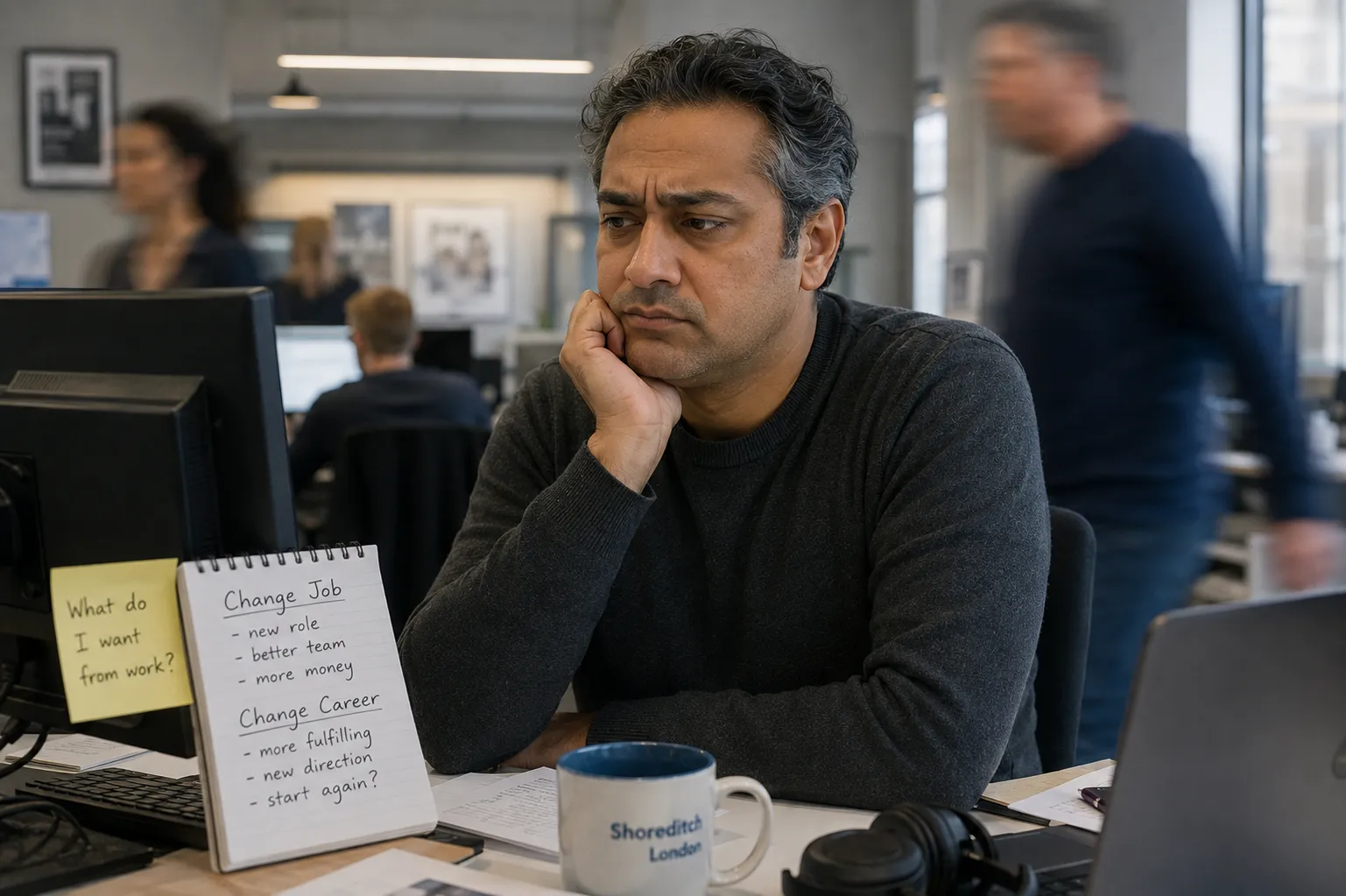
There’s a particular kind of stuck that many thoughtful professionals recognise.
You may not be completely miserable or in crisis. On paper, things look reasonably solid. You’re earning, you're stable, and you're progressing — at least, in a conventional sense.
But still, something doesn’t quite sit right.
You find yourself thinking about other directions, wondering what else might exist. Perhaps you're feeling drawn to something different — more meaningful, more energising, or just more aligned with who you are now.
But then money enters the picture.
And suddenly everything gets complicated.
Because now, the question isn't just "What would I like to do?"
It becomes:
And before long, the exploration slows down, the ideas start to narrow, and the practical concerns grow louder.
There might not be a fanfare; just enough of a niggle that staying where you are starts to feel like the most sensible option.
This is very, very common — and completely understandable.
Because money doesn't just affect career directions and outcomes. It shapes what feels possible in the first place.

We recently asked members in the Thriveherd Community about their relationship with money and career change. While this is early data, the patterns were consistent.
When asked how money feels when thinking about career change, around three quarters of respondents described it as either a constraint or something that needs protecting carefully. Only a minority described money as something that enables options.
When we asked about financial situations, half of respondents described things as manageable but limited, while a further group said things felt tight with little room for error. Only a small proportion described their situation as comfortable and supportive.
And when we explored the worries that show up most often, concerns about losing stability appeared more frequently than concerns about earning less — with anxiety about making the wrong decision also featuring strongly.
This is important.
Because it suggests that, for many thoughtful professionals, the biggest barrier isn’t necessarily salary but stability.

One of the assumptions about career change is that people stay because they’re highly paid. Sometimes that’s true. But often, it’s not really about salary at all — it’s about stability.
A steady income, familiar expectations, and predictable routines can make staying feel like the sensible option, even when the work itself no longer feels energising.
We’ll come back to this shortly, because stability — alongside salary — is one of the main ways money can keep people stuck.
We also saw something else in the data.
Around 50% of respondents said they often dismiss career ideas that they suspect could be financially unrealistic. Others said they struggle to explore options without worrying about money.
Which means money isn’t just influencing decisions.
It’s limiting career changers' imagination, even if (and here's the kicker) they don't know that their route forward is actually blocked.
And this can quickly derail a career change. Because once your imagination narrows, it becomes much harder to see alternative paths.
Don't get me wrong: it’s completely reasonable for money to influence your choices. In fact, for most people, it probably should.
But there’s a meaningful difference between being constrained by facts and being constrained by assumptions.
Limiting your options early only really makes sense if:
If those conditions don’t apply, shutting down exploration early often works against you.
Because in practice, three things tend to happen when people explore ideas they initially doubt:
In other words, exploration doesn’t commit you to change. It simply improves your understanding of what’s possible.
And without that understanding, it’s very difficult to make a well‑informed decision about whether change is actually worth it.
Because ultimately, the question isn’t just whether change is possible; it’s whether it’s worth it in all the circumstances, given the trade‑offs involved.
And you can’t properly answer that unless you allow yourself to explore the idea in the first place.
This is why narrowing your imagination too early can be so limiting.
Not because money shouldn’t matter, but because exploration is what allows you to understand how money actually fits into the decision.
Sometimes, the constraint is obvious.
You’re well paid. You've built a lifestyle around that income. There may be a mortgage, family commitments, or simply expectations that have formed over time.
Even if you're no longer enjoying the work, the idea of stepping away can feel risky.
This is often called the "golden handcuffs" effect.
The more established you become financially, the harder it can feel to move. Not because you can't, but because the stakes feel higher.
There’s also identity involved.
High-paying roles often come with status, recognition, or a sense of professional credibility. Leaving can feel like stepping backwards, even if you're moving toward something more meaningful.
And then there’s lifestyle.
Over time, expenses tend to grow to match income. Not always dramatically, of course — usually it's gradual. A slightly nicer home, a bit more flexibility, fewer financial constraints.
None of this is unreasonable. It can be great! But it does mean that change can feel more... consequential.
So even if you’re ready for something different, the financial implications make you hesitate.

But high salary isn’t the only way money keeps people stuck.
Sometimes, as I mentioned above, it’s stability.
You might not feel particularly well paid. But the income is reliable, the hours are predictable, the benefits are clear – and there’s a sense of security.
And when you're considering change, that stability can feel very valuable indeed.
This often shows up in professions like education, healthcare, public sector roles, or long-tenure positions — though it can happen anywhere.
The role may no longer feel energising. You may feel ready for something different. But stepping away from stability feels like stepping into uncertainty.
Even if the long-term outcome could be better. And this is where thoughtful professionals in particular often pause.
Not because they lack ambition, of course – but because they tend to weigh consequences very carefully.
Which makes absolute sense, because stability matters.
But when stability becomes the only deciding factor, it can severely narrow your options.

When people talk about money and career change, the conversation often centres around salary.
But in practice, the fears are broader.
You might recognise some of these:
These might not appear as dramatic statements. More often, they show up as hesitation. Like:
None of these are irrational; they’re thoughtful responses to uncertainty.
But that's exactly what makes them such tricky customers. Because they seem to make sense. But over time, they can make staying feel easier than exploring – and then nothing changes at all.
One of the patterns we see often at Thriveherd is that thoughtful professionals tend to experience this tension more strongly.
They consider trade-offs carefully, they think long-term, and they value responsibility.
Which means they’re less likely to make impulsive moves — and more likely to weigh financial consequences.
This is a strength.
But it can also make exploration feel harder because it slips easily into risk aversion and analysis paralysis.
The more thoughtfully you consider risk, the more risk you see – and when that happens, staying where you are starts to feel like the most sensible option.
Money is important. Categorically. It provides stability, security, and options.
But sometimes, it begins to shape your decisions more than you intended.
You might find yourself staying in a role not because you want to — but because it feels safer.
You might postpone exploration because the financial picture isn’t perfectly clear.
You might narrow your thinking to what feels practical, rather than what feels meaningful.
And bit by bit, your career choices can feel more constrained than they used to.
At that point, it can be helpful to step back and ask:
Is money supporting my direction? Or limiting it?
One of the biggest misconceptions about career change is that it requires a dramatic leap.
In reality, many people move forward through exploration and smaller actions.
They explore ideas, test options and build confidence over time.
They don’t necessarily quit immediately or take a pay cut right away.
Instead, they create space to explore safely.
This might involve:
This approach reduces risk — and makes financial concerns easier to manage.
It also helps rebuild confidence.
Because instead of imagining worst-case scenarios, you're gathering real information – and that often makes change feel more manageable.

If this resonates, you might consider:
Money is a powerful influence in career decisions. It’s entirely reasonable to consider it carefully.
But when financial concerns begin to narrow your thinking, it can help to step back and create space for exploration again.
Because career change doesn’t always require certainty.
Sometimes, it just starts with curiosity — and a willingness to explore what might be possible. This can be exactly what you need to give momentum a chance to build. Because hey – if you let doubts and assumptions stop you, without fact-checking them: where will exploration ever get you?
Not necessarily. Considering change and making change are different things. Exploration helps you understand what's possible before making decisions. In many cases, people discover more financially viable options than they initially expected.
Golden handcuffs refer to situations where a high salary or financial benefits make it difficult to leave a role — even if the work is no longer fulfilling. The financial rewards increase the perceived risk of change.
Stability offers predictability, security, and reduced risk. Even if the work itself isn't fulfilling, the certainty of income and structure can make staying feel like the most sensible option.
Many people explore gradually. This might include conversations, experiments, learning new skills, or testing ideas alongside your current role. Exploration reduces uncertainty without requiring immediate change.
A useful starting point is to research specific paths in more detail. Speak to people already doing the work, explore different routes, and understand timelines. Often, the reality is more flexible than initial assumptions.
Follow us on social media: