Confidence–Context Gap
Unsupported Confidence
Evidence-Based Confidence

Thriveherd blog
Get practical insight on career change, confidence and purposeful work.
Short, thoughtful emails without noise. Unsubscribe anytime.
The 3 types of confidence most people confuse – and why that matters more than trying to simply “be more confident”.

Something like this has probably been whirring in your head for a while:
You’re capable, you’ve built experience, you’re not new to work (or to taking things seriously, for that matter) – and yet your confidence feels… uneven. Fine in some moments; weirdly unreliable in others; dropping just when you’d hoped it would lift.
Maybe it shows up when you try to speak up; or when you have to make a call without checking it three times; or when you’re edging towards something new and realise you don’t quite trust your own read on it yet.
Thing is, the uncomfortable part isn’t just the doubt itself; it’s the mismatch. The sense that, at this stage of your career, you should feel more certain than you do. It often shows up as what people might call self-doubt at work, in a way that's persistent enough to affect how you speak, decide, and show up.
And once that thought lands, it can sort of grow legs. It becomes less, “Why am I unsure here?” and more, “Why am I less confident than I should be?”
For a lot of people, this gets labelled as low confidence at work; or just a general sense that their confidence at work isn’t where it should be. But that label, while understandable, can be a bit misleading.
But before we jump to fixing anything – which is usually, and understandably, the instinct here – it’s worth slowing down and asking a slightly different question.
Because what you’re calling “low confidence” might not be what you think it is.
A lot of confidence advice is built on a slightly creaky assumption: namely, that confidence is one single thing which you either have or don’t have, and that if you don’t have enough of it, the task is to somehow generate more through mindset shifts, positive self-talk, or sheer determination.
Now, to be fair, those things can sometimes help. I'm not pretending thoughts don’t matter – they absolutely do. But the problem is that they often enter far too early in the conversation, before we’ve even worked out what kind of confidence challenge we’re dealing with.
Because confidence isn’t one thing. It isn’t a single inner resource sitting in a tank somewhere, waiting to be topped up. It’s more complicated than that (and, thankfully, more specific).
What people often call “low confidence” can actually point to several different underlying issues. Sometimes it is about self-worth. Sometimes it is about capability. And sometimes (which is the bit many people miss) it is less about belief or ability than about evidence.
By "evidence" I mean whether you have enough lived proof, enough exposure, enough familiarity, or enough recent experience for your nervous system and your self-trust to feel more settled.
If you get that diagnosis wrong, you end up trying to fix the wrong thing. You work on belief when the issue is unfamiliarity; you question your ability when the issue is lack of recent evidence; you assume something is fundamentally wrong with you, when really you may just be navigating waters that haven’t become familiar yet.
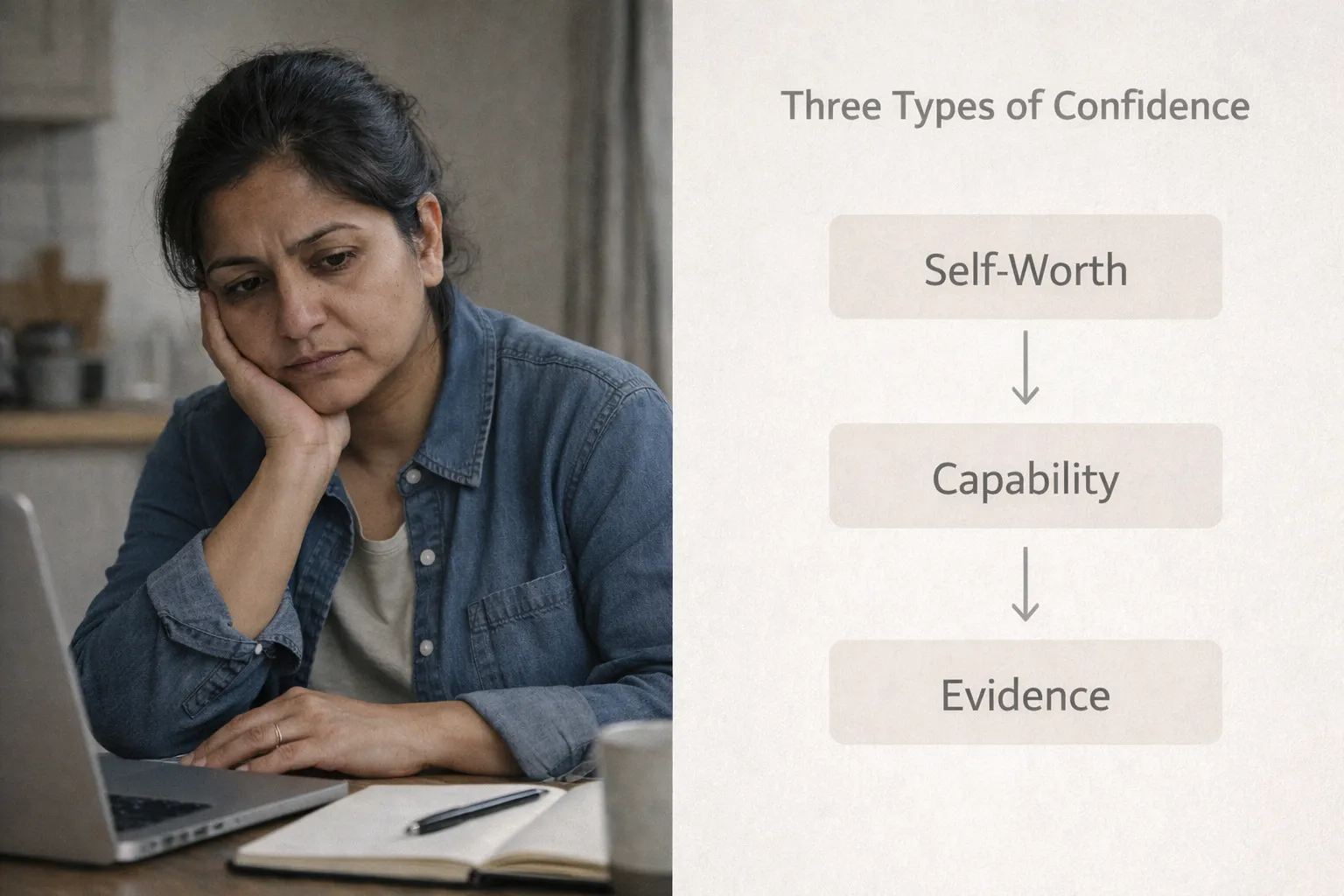
Once you start separating confidence into different forms, quite a lot of professional self-doubt begins to make more sense. Not all at once, perhaps, sure; but enough that you can stop treating yourself like a mystery and start asking better questions.
This is the broadest layer, and probably the one people think of first when they hear the word confidence. It’s that deeper sense of whether you feel fundamentally OK and good enough; i.e. whether you have a stable sense of worth that isn’t constantly at the mercy of performance, approval, or external comparison.
If this layer is shaky, it tends not to stay politely in one corner of your career. It often shows up across different parts of life: in relationships, in decision-making, in the way you interpret mistakes, criticism or silence. You may notice persistent self-criticism, a tendency to discount your strengths, or a feeling that even when things go well, they never quite land as evidence that you’re actually all right.
This type of confidence matters, clearly. But it’s also worth saying that it is not always the main issue for thoughtful, capable professionals who feel low confidence at work or in their career. Sometimes it is, yes; often, though, something more specific is going on.
This type is narrower and more situational. It’s less about, “Am I good enough as a person?” and more about, “Can I do this?”
Can I lead this conversation? Can I present clearly? Can I navigate this challenge, this role, this level of responsibility, this unfamiliar task?
Capability confidence usually improves with practice, preparation and repetition; which is why so much conventional advice lands here. Learn the skill, rehearse the task, build competence, do it again. And, to be fair, that is often useful. If you’ve never chaired a meeting, handled a negotiation, or spoken publicly, then some of what feels like low confidence may simply be low fluency.
And this overlaps with evidence:
This is the one that tends to matter most for a lot of Thriveherd-type readers; and it’s also the one most commonly mislabelled as some form of personal shortcoming.
Evidence-based confidence isn’t really about self-worth, and it isn’t exactly about capability either (although there is overlap, as we've seen). It’s about whether you have enough relevant, recent, context-specific proof to feel steady in what you’re doing.
And by "proof" I mean actual lived experience of the thing in question (or something quite like it).
In other words; have you seen enough, done enough, tested enough, stretched enough, and gathered enough lived evidence in this particular context for confidence to feel justified?
If this is the issue, it often has a very particular feel to it. You’re not completely lost, but you’re not settled either. You feel less confident than you think you should. You might be perfectly capable, but you’re in a newer environment, a bigger stretch, or a less familiar phase. You may be unsure what's expected of you – perhaps relationships have changed or the rules are unclear – and often, other people can seem further ahead.
We see this a lot when people are starting over professionally, or even just stretching within their current role – the ability is there, but the recent evidence isn’t yet. (If that’s where you are, this guide on building confidence when you’re starting over goes deeper into that pattern.)
So the issue isn’t necessarily that you lack confidence in some deep, fixed sense. It’s that your confidence hasn’t caught up with the context you’re in.
And that, importantly, is a very different problem...

When confidence dips, the instinct is often to turn your focus inward. You assume you’re not confident enough, not ready enough, not experienced enough, not something enough; and once that inner story gets a foothold, it can colour everything.
But for many people, especially reflective professionals who are navigating growth, change, or some form of stretch, the issue is often more situational than personal. This is particularly true when it comes to confidence at work, where the goal posts of expectations, environments, and feedback loops are constantly moving.
It isn’t necessarily that they lack self-worth; it isn’t even always that they lack capability. It's often that they lack enough exposure to this level, enough clarity around what’s expected, enough recent evidence in this environment for their confidence to feel deserved.
As most of us know, there are certain moments in career life where this becomes especially pronounced. A move into a more senior role, for example; or a shift into a new field; a transition after redundancy; the early stages of building credibility in a different direction; or simply being in rooms where you no longer feel like the person who knows how things work. It's often said it takes at least a year in a new role or environment to start feeling like part of the furniture. So it's no wonder that when something changes, we feel it.
At that point, confidence can drop quickly; not because your ability has evaporated overnight, but because the old evidence isn't as relevant any more. It belongs to a different context.
So the real issue may not be, “Why am I so unconfident?” It may be, “Why am I expecting myself to feel at ease in conditions that aren't yet familiar?”
That is a much better – and fairer – question.

This is one of the more important things to understand about professional confidence (and, if we’re honest, one of the more irritating). And it's often the answer to a very common question: why does confidence drop in new situations, even when you haven’t suddenly become less capable?
Confidence is deeply tied to familiarity.
When you know the jargon, the norms, the standards, the unwritten rules, the kinds of decisions that get rewarded, and the signs that you’re doing all right, confidence tends to be easier. Not because you’re magically a better person in those settings, of course, but because you can orient yourself. You know where you are.
But then you step into a new role, or towards a new direction, or into a higher-stakes stretch. Being promoted to manage your former peers is a classic example of this, because it's a double whammy. Suddenly, everything you thought you knew is up in the air – relationships, rules, expectations, skills, experience, all of it. You no longer know exactly what good looks like; you’re less sure how others are judging your performance; you can’t read the room as easily; and your internal certainty starts to shake.
Thing is, that shake is often interpreted far too harshly. People read it as proof they’re not suited to this, not ready, not good enough, not doing well, not cut out for what comes next. But often it means something much more ordinary than that.
It means, simply, that you have moved beyond what is familiar.
And confidence, being partly a response to familiarity, hasn't yet adjusted.
In that sense, feeling less confident is not always a warning sign. Sometimes it is just the cost of entering unfamiliar territory before it has had time to become yours.

If you’ve ever wondered how confidence is actually built – not in theory, but in real working life – this is where things can start to become clearer.
Most people try to build confidence directly; which is understandable, but not usually the most effective route. They try to think their way into it, talk their way into it, or pressure themselves to "fake it till they make it", i.e. acting more confidently before the underlying conditions are there.
But confidence usually builds sideways, not upwards: through the things that create the conditions for self-trust, rather than through self-trust itself.
One part of the process is simple exposure – being in the room more often, hearing the language, watching how things work, noticing what is actually expected rather than what you fear is expected.
Exposure matters because so much self-doubt at work is fed by gaps or distance. When you’re standing outside a situation, imagining it, you often fill those gaps with assumptions. And let's be honest: those assumptions are not usually kind.
Then there is experimentation – Thriveherd initiates will not be surprised to see this making an appearance – small, low-stakes, real-world action that gives you data.
This is important because confidence does not grow especially well through endless thought or keyboard tapping. It grows through contact with reality. Through trying something, seeing what happens, learning from it, refining, repeating. Not giant leaps, usually; just enough movement to replace abstract fear with lived evidence.
This is essentially what we formalise inside Thriveherd’s Career Experiments approach – turning “What should I do?” into “What could I test?” – because clarity and confidence tend to follow action, not precede it.
There is also the effect of proximity. Spending time around people who are doing what you are trying to do, or navigating waters similar to your own, can be surprisingly... regulating. Not because they solve it for you, but because they make the experience more human-sized and offer insights you'll actually listen to.
You begin to see that others are not as polished, certain or innately confident as they may have looked from afar; and that real confidence is often far less dramatic than we imagine.
This is one of the reasons community settings matter more than people expect; not for some abstract idea of motivation, but for perspective, normalisation, and sometimes to borrow confidence until your own catches up.
And then, of course, repetition. Because the more often you do something, the less psychologically loud it becomes. Several books about habit-forming have appeared in on the self-help shelves recently, but I'm not going there. Instead, we can simplify and say that familiarity reduces uncertainty, and as uncertainty reduces, confidence gradually starts to rise.
That’s why it is often more helpful to think of confidence as an outcome than a starting point. It is not usually the precondition for action, and if you wait for confidence to appear magically, you might be waiting longer than you need. More often, confidence is what action leaves behind.
At this point, the useful question is not simply, “How do I build more confidence?” but, “What sort of confidence problem is this?”
Here's a quick triage:
You can ask yourself a few simple questions here; not to interrogate yourself, but to bring a bit of clarity into the picture.
Quite often, people discover that what they have been calling low confidence is better described as unsupported confidence; i.e. confidence that has not yet had the conditions it needs.

Instead of trying to “be more confident” in the abstract – because what are you supposed to do with that? – it’s usually more helpful to focus on the conditions that confidence can grow from.
So start with one situation. Not your whole life or your whole identity; just one area where your confidence feels shaky.
Then ask yourself what might actually be missing here.
Is it self-belief?
Is it skill or other capability?
Or is it evidence?
If it’s evidence, then the task is not to think harder until certainty arrives; it’s to build more reasons to trust yourself.
What might that mean? Well, it could be putting yourself into the environment more often; taking smaller steps instead of waiting for full readiness; getting closer to people who are already operating in that space; asking better questions; running low-stakes experiments; repeating the experience until it begins to feel a little less mountainous.
And sure, that may sound less dramatic than a breakthrough moment. But as most of us know, it’s usually how things actually improve – bit by bit, not overnight.
Confidence – or what we might more broadly call professional self-belief – grows through support, exposure, evidence and practice – which is one reason it can be so difficult to build in isolation. Sometimes what people need isn't more pressure to “back themselves”, but more structure, better reflection, and more opportunities to test things properly – often alongside others in the same boat.
To bring this together, I'll say this: you don't necessarily need to become 'a more confident person' – whatever that means.
You might simply need more reasons to feel confident in the situations that matter to you.
That, I hope you'll agree, is a different thing altogether: gentler, more practical, and, in most cases, actually more accurate.
Because often the issue is not that you are somehow broken, or uniquely doubtful, or failing. It is that you're asking confidence to appear before enough evidence exists to support it.
Over time – through exposure, experimentation, repetition, and more kindness toward yourself – that can change.
So perhaps the better question isn’t, “How do I become more confident?”
It’s: what would need to change in my experience for confidence to feel justified here?
If you’ve been trying to fix your confidence directly and getting nowhere, it may not be a motivation problem or a mindset problem at all – it may simply be that you’ve been working on the wrong type of confidence.
Often, it’s because your confidence is being asked to operate without enough recent or relevant evidence. You may be capable; but if the context is new, stretched or unclear, confidence can feel lower than you expect.
Low confidence at work can come from several sources; including self-doubt, unclear expectations, lack of recent experience, setbacks, unfamiliar environments, or pressure that has outpaced familiarity. This is one of the most common reasons people experience low confidence at work, even when they are capable.
Self-doubt is often the moment-to-moment questioning of yourself; low confidence is the broader sense that your self-trust is unstable or reduced. The two overlap, clearly, but they are not quite the same.
Yes; absolutely. This is very common. Capability and confidence are related, but they are not identical. You may have the underlying ability, while still lacking enough evidence or familiarity for confidence to feel solid.
Because new situations remove familiarity; and familiarity is one of the things confidence quietly relies on. When the rules, standards and expectations are less clear, uncertainty rises, and confidence often dips with it.
Usually by building evidence rather than waiting for certainty; through small actions, repeated exposure, experimentation, support and practice. Confidence tends to follow once your experience gives it something real to stand on. To get more clarity and support with this and to accelerate confidence-building, consider working with a career coach.
Second-guessing yourself at work is often linked to uncertainty or lack of recent experience in a situation. When expectations are unclear or you haven’t yet built enough evidence, your brain fills the gaps with doubt.
Follow us on social media: