Career Singularities
Active Regret
Haunting Selves
Thriveherd blog
Get practical insight on career change, confidence and purposeful work.
Short, thoughtful emails without noise. Unsubscribe anytime.
Only at the barriers did it hit me. I’d cut my ID in half, said a few cheery goodbyes, hummed in the lift down, skipped out of Scotland Yard and up to the barriers at St James’s Park tube station – and stopped short. Unlike 20 minutes earlier, when I’d still been a police officer, I’d have to buy a ticket. A sudden punch: I wasn’t a cop any more.
Until that point, everything about resigning had felt right: it would help me heal after a few tough times, it would give me my life back, and I knew I didn’t ever want to be a retired cop. And my plan was to work in food, a real passion: so that had to be the best move – right?
Then again… what if I’d moved department? Gone for promotion? Taken that secondment I’d been offered? Or, come to think of it, what if I hadn’t given up on academia before becoming a police officer in the first place – perhaps everything would have been easier from the beginning.
We all have moments like this. Over 12 years later, I still think back to that gut-punch at St James’s at least once or twice a week. It’s always felt pretty neat, the tube station setting: memory and decisions as a track with curves and stations and switch points.
In the words of Robert Frost, I took the path I thought “had the better claim” – and here I am, over a decade down the line, “telling this with a sigh ... ages hence”.
Except I’m no longer sure “The Road Not Taken” got this quite right. Most of us think of past decisions as ‘forks in the road’ and ponder what could have been. But that’s not really true, is it – because if something’s truly behind us, why does it linger?

The lingering isn’t always the same. I did go on to work with food after leaving policing – but I was a grumpy classmate at Leiths School of Food and Wine, still very much affected by both PTSD and the abrupt identity shift. Both of those were relevant when I decided not to work with food after all. (Turns out passion doesn’t always lead to a good career move.)
So what happened then? Another career regret, of course. And they’re not the only ones: they just join the list of careers that could have been. Academic, intelligence officer, senior detective, chef, photographer, food stylist, food writer, author, tour guide, linguist, senior civil servant, actor, psychotherapist.
Which of these haunting selves do I regret not becoming? All of them.
Does that mean I’m unhappy with the way things have gone? No.
The more I became acquainted with my haunting, unfinished selves, the more I realised that each of them is actually a different person.
And I’m not!
Or at least, that’s not how I experience myself. Sure, this is a well-trodden area in philosophy: is the cart still the same cart if every plank, wheel and nail is replaced? Can you step in the same river twice?
And so on. But that’s all conceptual. Which is nice, but tricky to do anything with. What really matters is how we experience ourselves – and even though a lot has changed, I’m fairly clear in my own mind: I was me then, and I’m me now.
But here's the rub: the career world doesn’t like to think of people in this way. Every role, path or career identity is presented as a discrete personage. And this cuts to the heart of many struggles experienced by those unhappy with their work or navigating a career change. Because we’re often encouraged to choose between entire selves.
Become the academic.
Become the manager.
Become the creative.
Become the entrepreneur.
Each path is presented as if it expects the individual to be a different personality, a different temperament, a different identity.
Over the years I've spent helping others develop and change their career paths, I've noticed that roughly half ask the following question when I ask them to complete self-assessment exercises:
Should I answer this as my personal self, or my professional self?
And there you have it: identity fracture isn't just a theory. It's deeply ingrained in our assumptions about work.
What this leads to is inevitable friction when we look back – because we don’t just lose one road. We lose an entire version of ourselves.
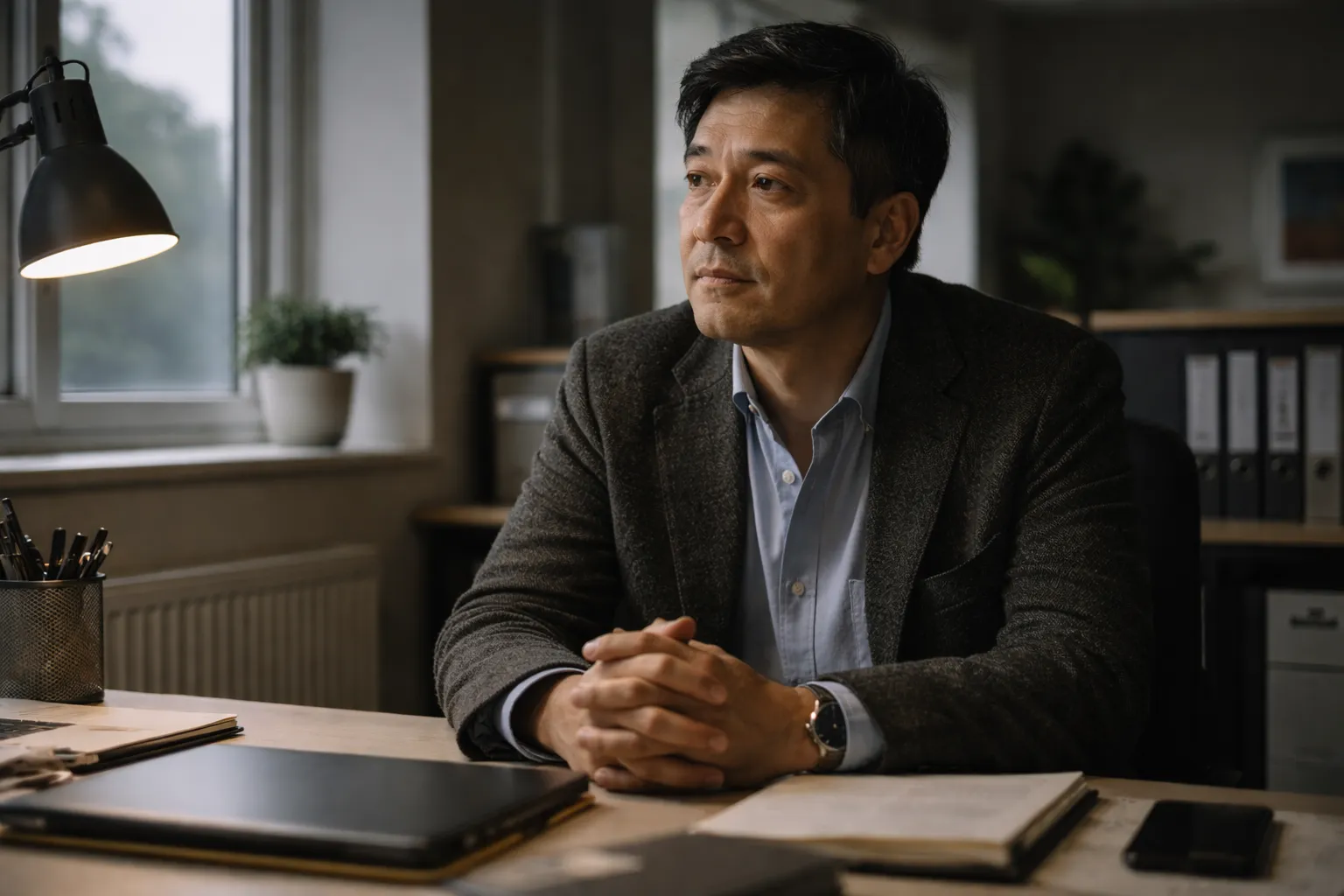
Once you start noticing these fractured, haunting selves, you begin to see them everywhere.
Arnie, for example, had done everything right. Senior role, strong salary, respected in his field. From the outside, it looked like success.
But he spoke about his career as though it belonged to someone else.
He’d climbed steadily, taken opportunities, made sensible decisions. But there was a real emptiness in the way he described it all.
At one point he paused and said, almost apologetically, “I think I became someone before I realised I had a choice.”
There was no obvious regret, and (take note, Robert Frost!) no fork in the road. Just the gradual realisation that a quite different version of himself had faded somewhere along the way.
For Sarah, there was no dramatic moment or decisive fork; just a gradual attrition of meaning.
Each role made sense at the time, and every move Sarah made felt reasonable. But over time, everything started to wear thin.
It wasn't exactly dissatisfaction Sarah felt, or even unhappiness; there was just a growing sense that she was drifting away from something she couldn’t quite put her finger on. And as the drift happened, so the ghosts started to appear – those haunting selves, different lives, different decisions.
Marcus was different: he knew exactly what he was doing.
He decided to stay in a role he disliked, fully aware of the trade-offs. Stability, family and predictability all mattered more to Marcus than job satisfaction.
“I’m choosing misery,” he said to me once.
And he was only half-joking, because there was something serious beneath it. He wasn’t regretting a past decision; he was living inside a present one.
Still, even then, there was a sense of regret because Marcus was haunted by the selves he wasn’t becoming. The ideas he didn’t explore, the directions he didn’t pursue.
Some of you reading this might agree with Marcus's decision to choose misery – others will feel disappointed for him, or perhaps feel that he made the wrong choice.
Below, I'll argue that Marcus actually made a deeply moral choice – whether you agree with it or not.

These case studies help us acknowledge a new kind of career regret.
We often think of regret as retrospective, as something we feel about decisions already made. But these examples show us there is another kind: the feeling that we are becoming someone we’re not entirely sure about.
We might think of this as regret in motion.
Not about the past, but about how the present is unfolding into the future.
Active regret appears when we notice a particular kind of direction forming. Perhaps when a role begins to solidify, or when a new identity starts to settle.
And we start noticing feelings of unease emerging along the way. It's probably not as clear as "What self am I becoming?" or "What selves am I leaving behind?" – because nobody actually thinks like that.
It would probably be more like:
Hmm, I'm not sure everything feels completely right about this.
This feeling can be persistent. Because, effectively, every step forward is also a step away. And not every step forward takes us in a direction that feels good.
Seen this way, regret starts to look less like a problem and more like a signal we can pick up on.
And I'm going to further and say: this is a signal we have a moral duty to listen to.
That might come across a bit strong, but hear me out...
The moral imperative isn't about some grand, sweeping gesture of rebellion or a dramatic "I quit" speech delivered to a bewildered boss on a Tuesday morning. It’s much more internal – and, frankly, a lot more demanding.
I'm talking about a duty to stop pretending that the trade-offs don’t exist. We have a moral obligation to remain conscious of the cost of our lives, because the second we start numbing that "gut-punch" feeling or explaining away our haunting selves as "childish fantasies," we slip into a state of living that is – basically – dishonest.
Existentialists like Sartre would call this a refusal of Bad Faith, but we can call it simply refusing to be a passenger in your own skin.
The moral duty, then, is to keep the books balanced. To look at the career you’ve built and say, "Yes, I am doing this, and yes, it has cost me the academic, the chef, and the traveller."
This isn’t wallowing; it’s an act of integrity. When Marcus told me he was "choosing misery," he was actually performing a moral act – more moral than those who are drifting away from themselves without acknowledging it. Marcus did the hard work of looking his regrets in the eye and saying, "I see you, but I am prioritising something else." He hasn't eliminated his haunting selves; he’s just stopped lying to them.
By engaging with our regrets in this way, we meet the essential preconditions for actually owning the life we’re leading. You can’t truly own a house if you refuse to acknowledge the damp in the spare room, and you can’t own a career if you’re constantly trying to block out the noise of the versions of you that didn’t make the cut.
Much of the friction we feel in our working lives comes from this frantic attempt to keep the "professional self" hermetically sealed away from the "personal self," as if we’re terrified that letting them touch would cause some kind of short-circuit.
But once you accept the moral signal of regret, the short-circuit happens, the lights flicker, and suddenly you can see the whole room for what it is.
It might result in you handing in your notice – but it might not. It could just mean you start showing up to your desk as a whole, albeit slightly haunted, human being rather than a fractured identity. That honesty is the only thing that stops a career from becoming a decades-long performance, and while it might be uncomfortable to sit with those ghosts at the tube station barriers, it’s a hell of a lot better than pretending they aren’t standing right there next to you.
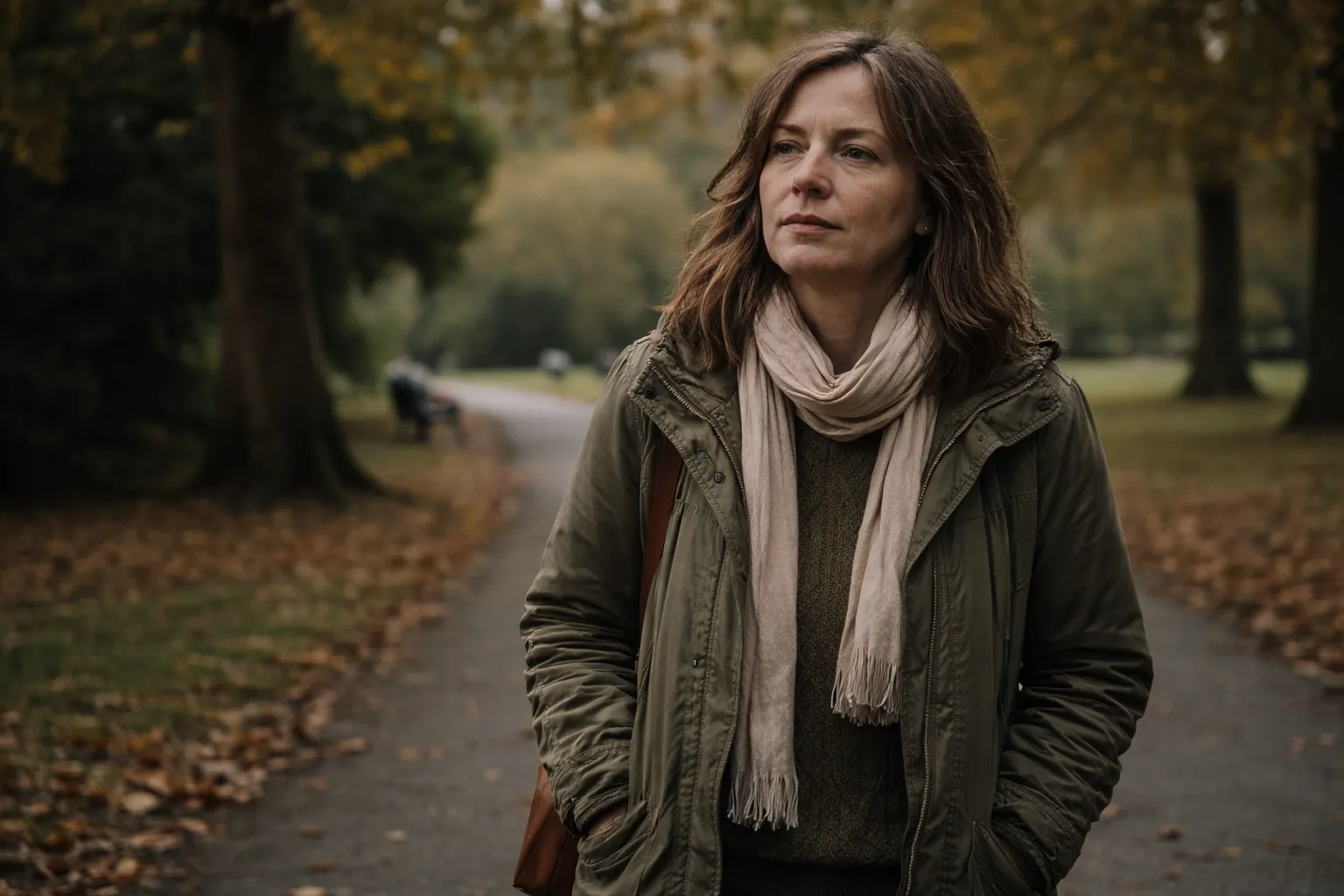
This honesty brings us back to that yellow wood and those two diverging paths. We’ve spent a century misinterpreting Frost’s poem as a celebratory anthem for the rugged individualist – the bold soul who chooses the "less travelled" path and reaps the rewards.
But Frost knew better, I'm guessing; he titled it The Road Not Taken, not the road he actually chose. The poem isn’t about the glory of the path; it’s about the "sigh" of the traveller who knows that in choosing one thing, they have effectively murdered a thousand other possibilities.
The moral imperative isn't to find the "perfect" path where no regret exists. (That's such an important point I want to shout it every time I start working with a new career change client.) Such a place doesn't exist, and anyone selling you a career that promises "no regrets" is usually selling you a lie.
The duty is simply this: to be the person who tells the story with the sigh.
Not necessarily to aim for the same outcome as Marcus – because happier endings are certainly possible. But standing in the woods, fully aware of the paths you're not taking and the selves you're not becoming, rather than wandering blindly through the undergrowth.
I realise now – after some years of not infrequent anguish – that when I stood at those barriers at St James’s Park, the punch to the gut wasn't a sign that I’d made a mistake. It was just a moment of consciousness. It was the sound of the switch point clicking into place. We don’t have to live a life free of ghosts; we just have to be brave enough to acknowledge they are travelling with us. In the end, perhaps the path we walk matters less than actually walking it – haunting selves, sighs, and all.
Follow us on social media:




%20(1).jpg)
.jpg)