Thriveherd blog
Get practical insight on career change, confidence and purposeful work.
Short, thoughtful emails without noise. Unsubscribe anytime.

This guide will show you how to feel more confident at work – or for a new direction of work – as you navigate this new chapter.
You might have been competent, trusted, experienced in the past – the go-to person for answers. Back then, you knew the language and you could instantly read the room; you understood how decisions were made, where influence sat, what was expected of you.
Then something shifts. A new direction, a redundancy, a deliberate choice. And suddenly, you’re feeling like you're back at beginner level – asking questions you once answered for others.
As most of us know (or have experienced), confidence can feel very fragile in transition. One Thriveherd Community member said it perfectly in a recent confidence workshop:
“I’ve started this career change journey at a time when my negative self-talk is at its worst… but hearing others’ thoughts really helped me reframe my own.”
That right there is the tension.
You’re not incapable. Trust us. You’re just in unfamiliar territory, without the evidence that used to steady you.
We see it all the time in the Thriveherd Community, where members who have led teams, managed budgets or built respected careers suddenly describe themselves as “starting from scratch”. But the key point here is that their ability hasn’t disappeared. The context has.
And here are two truths we return to again and again inside Thriveherd:
If you’re wondering how to be more confident when starting over professionally, you’re not alone. This guide will help you build your confidence in a realistic way.
Confidence is self-trust built through evidence. It grows when you take action, gather proof and update your beliefs through lived experience — not through thinking alone.
Confidence is self-trust built through evidence.
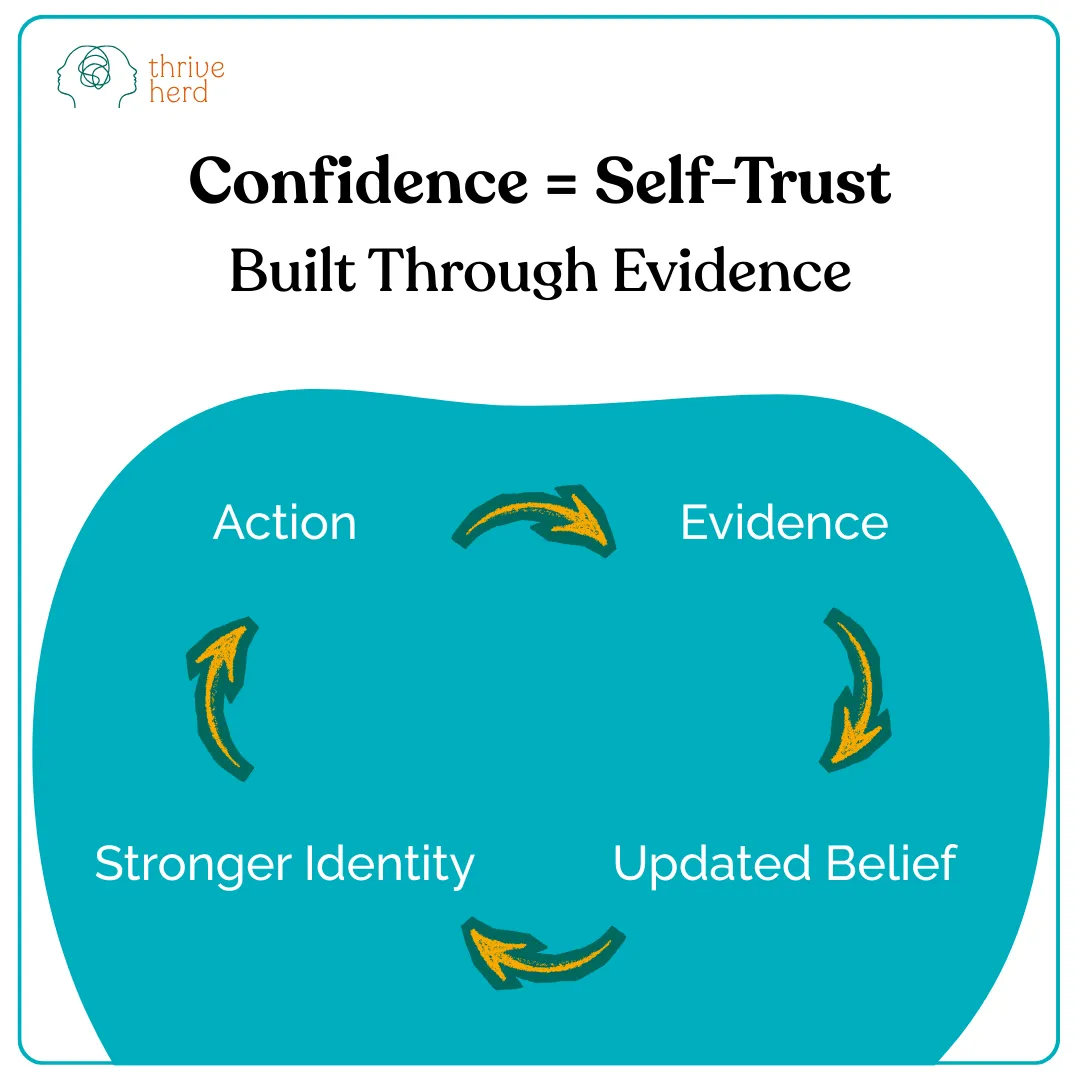
It grows when you take action, gather proof and update your beliefs through lived experience — not through thinking alone.
It’s the belief that you can handle what happens next, even if you don’t yet know exactly what that is.
And this is hugely important for career change, because many people feel the need to know with absolute certainty what the future holds before they make a decision or take action.
But as we all know, that’s not really possible – and yet this what stalls so many career changes.
People want to know everything, don’t accept that’s not likely, and so hold out indefinitely for a crystal clear future to present itself as if by magic.
So if you don’t want to be stuck in career limbo forever, you need to start trusting yourself that you are resilient and resourceful. That you can adapt.
“But what if I don’t believe that?” we hear you cry. Well, this is where our guide comes in. If you’re going to make this work, you need self-trust. And self-trust comes from evidence – because you can’t simply think your way into confidence.
Sure, reframing and cognitive techniques can be helpful – we use them regularly in coaching – but until you actually do something, none of that becomes embodied. The brain updates belief through lived experience: through action, exposure and stretching yourself slightly beyond what feels comfortable… and discovering you survived it.
When you’re changing career, your inner narrator can become harsh and absolute. A small wobble becomes proof you’re not cut out for this. A delayed reply becomes evidence you’re being judged.
We see these familiar thinking patterns regularly in the Thriveherd Community – all‑or‑nothing thinking, mindreading, catastrophising – especially when someone is stretching into a new space.
But those are interpretations, not facts.
If you’ve lost confidence at work or during transition, you haven’t lost ability.
You’ve lost recent evidence.
Career transitions destabilise identity.
You lose professional shorthand – the everyday jargon that nobody else understands but made you feel part of a particular career group. You lose recognised competence, status and familiarity. You lose the subtle pointers that often told you, “I know what I’m doing here.”
In practice, you may start to feel behind your peers, exposed as inexperienced, financially vulnerable or judged by others. Even if no one is saying it out loud, it can feel as though everyone else is further ahead.
Inside Thriveherd, we often hear this described as what we term a kind of 'confidence debt' – old workplace experiences that still throw out echoes. A redundancy that stung more than expected, a difficult manager whose criticism lingers, a missed promotion that still haunts you even though you wish it didn't.
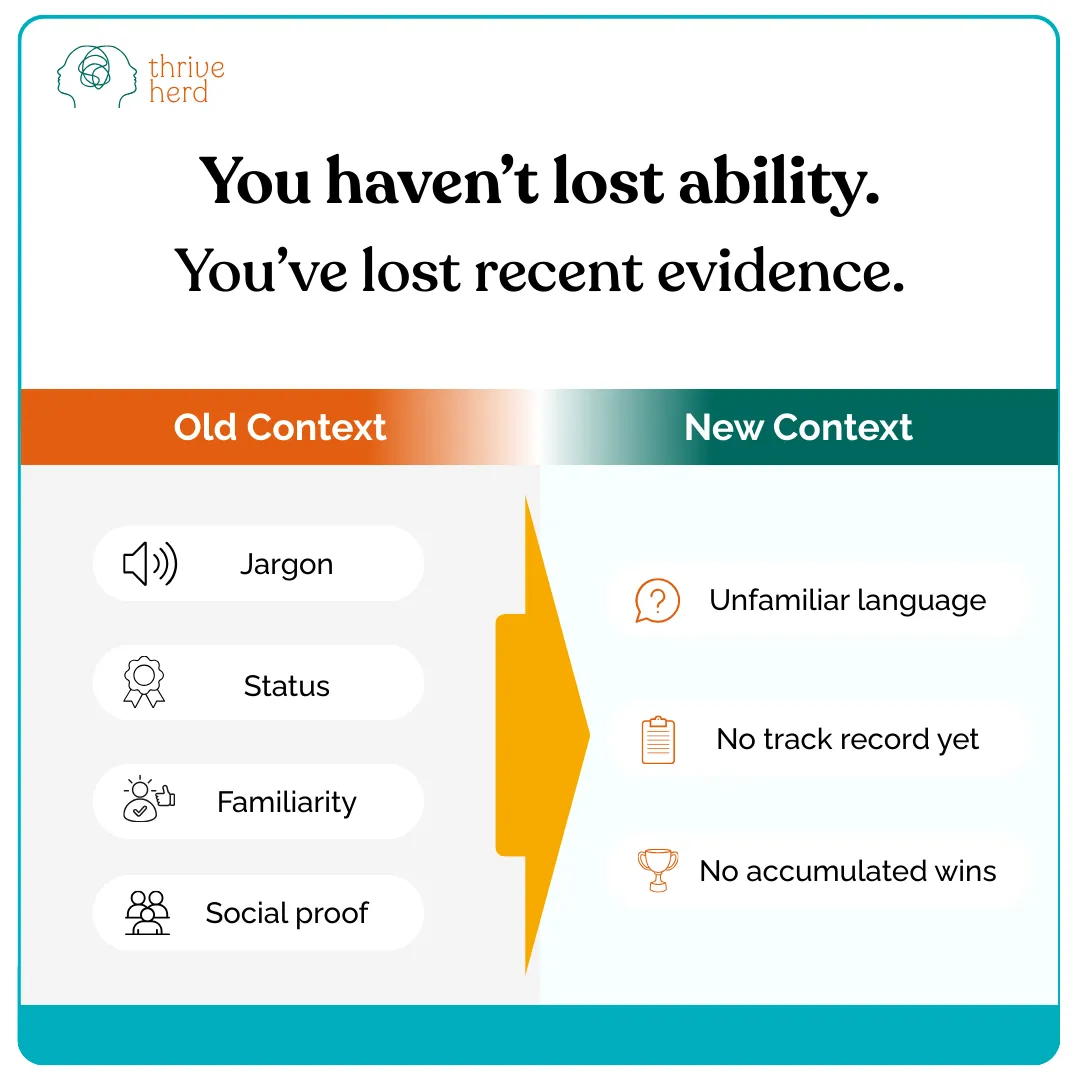
Thing is, when you step into something new, you don’t yet have proof that you can succeed there. You haven’t accumulated the small wins, the positive feedback, the rhythm that once anchored you.
So let's put it this way... You don’t lack confidence – you lack recent proof that you can succeed.
And that’s solvable.
If you’re wondering how to be more confident when starting over at work, the answer isn’t a personality transplant or a sudden rush of bravery. It’s a series of small, deliberate actions that rebuild evidence and reshape the stories you tell yourself.
Below are 17 practical ways to build confidence through experimentation, exposure and self-trust. These approaches also help if you’re specifically wondering how to build self-confidence at work after a setback or transition.
Every day, we make confident statements about the world – and about ourselves. We treat our assumptions as facts, rarely pausing to question them. But often they’re not knowledge; they’re stories.
“I wouldn’t be good at that.”
“I’m not experienced enough.”
“I should keep quiet.”
“I’ll never switch careers.”
Confidence drops not because of reality, but because of the narratives running in the background.
Pause and ask: Is this fact, or is this a story?
Stories shape feelings. Feelings shape behaviour. And behaviour shapes what becomes possible.
To interrupt the pattern, start a simple Story Log. When you notice resistance or self-doubt, ask: What thought came just before this feeling? Write it down without judging it. Label it as a story – not the truth.
OK, next step. Once you’re catching your stories, you can do something about them.
But let’s keep it easy. Pick one thought per day and reframe it in a way that keeps you moving. Ask yourself: “What would be a factually accurate but more helpful way for me to say this?”
From: “I’m inexperienced.”
To: “I’m building experience deliberately.”
We see members practise this inside our community all the time – not denying fear, but refusing to let it dictate the next step. Small narrative shifts build up over time.

New does not mean incompetent.
If you’re learning something unfamiliar, your competence simply hasn’t caught up yet. That gap is developmental, not personal.
Some people find it helpful to create some kind of visual reminder here, one they’ll see every day – a note on the fridge, a new lock screen on their phone. Something like “Gap-filling is part of career change” or “I want to learn new things for a better future”.
Once you embrace new experiences and upskilling as a core feature of career change and growth, you’ll be eager to leave thinking behind and start acting. This in turn will build your confidence.
This is about exposure, not inadequacy.
Do you really want to change or grow your career? If so, this could be one of the most transformational things you do:
Instead of aiming for a dramatic, high-stakes decision, design small lived tests.
We see it all the time in career changers – people who feel paralysed by the question “What should I do next?” suddenly regain momentum once the question becomes “What could I try this month?”

Confidence grows when you:
Clarity comes from lived experience, not analysis.
And lived experience builds evidence.
When you hesitate before sending a message or making a call, tell yourself: “Just 10 seconds.”
You don’t need to feel ready for the entire conversation. You just need enough courage to hold your breath (metaphorically!) and step into a ten-second bubble where normal rules don’t apply. Just 10 seconds – get it done. Then you can step out of the bubble if you need to.
Confidence doesn’t require certainty. It requires brief courage, repeated.
Let’s pop back to the quote at the top of this guide:
“Hearing others helped me reframe my own thoughts.”
Career change and growth can feel very lonely – and connecting with others can make your experience not only bearable but enjoyable. But what if you don’t really care about this? What if you’re not a people person or you’re quite happy you can do it alone?
Well, connecting with others isn’t just about sociabiliy or tackling isolation; it’s actually excellent problem-solving. When we try to push through alone, we limit our exposure to ideas, experiences and perspectives.
Confidence grows in safe spaces: we see this regularly inside Thriveherd sessions. Someone voices a doubt they’ve been carrying alone, and three other people nod in recognition. The shame reduces, the perspective widens and the next step feels possible.
When you realise your doubt is shared, it loses its sting.
When assessing choices, we often treat "what I think" as a single truth, but it mixes fluctuating feelings (influenced by sleep, stress, etc.) with objective evidence. To build reliable confidence, track them separately.
In your journal, log evidence (actions, feedback, skills) in one column and feelings (before and after actions) in another. If you're a deep thinker, you may even discover that this isn’t a confidence issue at all.
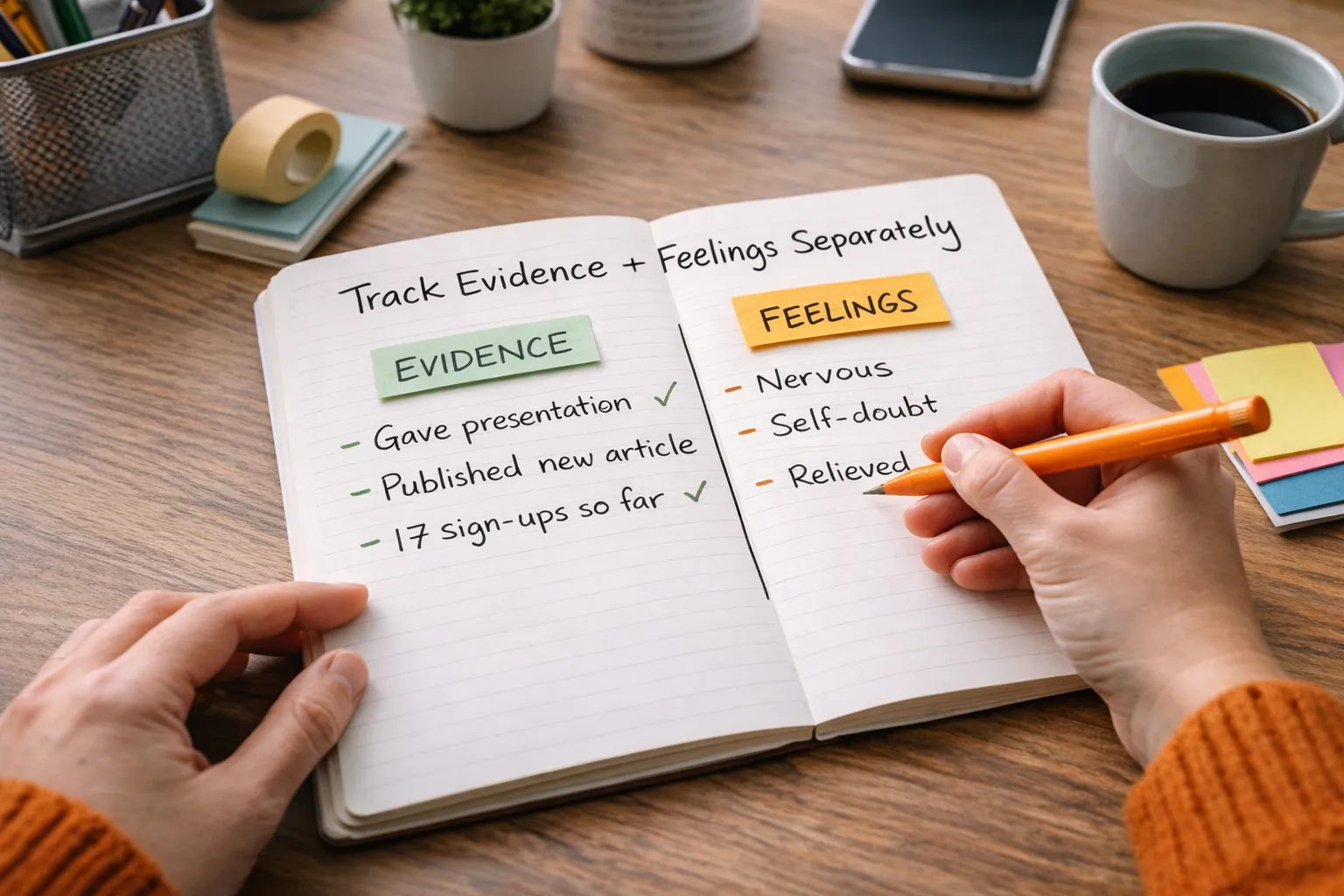
People often find feelings lag behind evidence (e.g., nervous before, proud after). Separating these helps your brain update predictions, better understand your emotional landscape, and track your objective assets.
Understanding both is key to reliable confidence growth.
One of the reasons people often stall or slow down during a career transition is this: there’s a lot going on. It feels overwhelming. So many things to do, people to talk to, choices to make. And this can feel a lot to trust ourselves with.
To keep things moving forward, one small, winnable action early in the day can change how you see yourself by lunchtime.
It might be drafting one paragraph, sending one message, completing one short module. But even small, quick actions help you snowball your confidence and success. Career transitions are usually built incrementally, not overnight.
Put another way: momentum becomes fuel for confidence.
Think of the last few times you met someone new – at the school gates, at a party, through mutual friends.
How many of those chats included the question, “So what do you do?”
We’re betting quite a few.
That’s because – rightly or wrongly – what we do is very closely linked to who we are (whether in our own eyes or those of others). And when we want to make a change, it can be tricky to take our identity along for the ride.
But often, the easiest way to move past an old, stubborn identity isn’t to take it with you or rip off the plaster, but to flirt with the future.
Think of it this way. Instead of clinging tightly to your old role or just magically inventing a new you, you're testing a 'possible self' – the kind of person you could become. Think of it like trying on a new coat.
So when you next meet someone new – today, tomorrow, next week – experiment with looser, more expansive phrases like:
This is the Provisional Identity Model in action. You play around with and refine introductions until they feel natural rather than forced. Language shapes identity more than we realise.

Don't forget about your motivation, either. Many people start over because they want to turn something they care about into work. But that transition brings its own psychological challenges – including the question of whether doing what you love for work can ruin it.
If your metric is perfection, confidence collapses quickly.
This comes up a lot for career changers, particularly those who are highly analytical and/or risk averse.
The problem isn’t risk aversion itself; it’s how we tend to respond to it. Normally, risk averse career changers will keep researching endlessly, hoping to find certainty before they act.
In reality, career transitions tend to be easier and more successful when they prioritise movement, flexibility and discovering as you go.
Ultimately, letting go of the need for perfect certainty isn't a sign of recklessness, but a recognition of how successful change actually works. Embrace the journey of discovery, prioritise making an informed first move, and understand that flexibility is your greatest asset in navigating a lasting career change and finding meaningful work.
Small, contained tests reduce overthinking and build self-evidence. Adding fast, low-stakes and low-cost experiments on a monthly (or even weekly) basis is likely to catapult your confidence and accelerate your career transition.
Inside Thriveherd’s Career Experiments Club, we encourage our members to move from analysis loops to tangible momentum simply by committing to one structured experiment at a time.
Each experiment asks: “What do I learn about myself here?”
Not: “Is this my forever career?”
Career is not a straight ladder. In fact, it’s not any kind of literal movement – trouble is, we’ve come to believe it’s true. And the consequence is that we are constantly creating problems for ourselves based on something that isn’t real.
How unhelpful is that?!
So instead of the rigid 'career ladder,' let's explore more useful metaphors. Perhaps a career is more like a lake we could swim around in, with currents, coves, and the occasional island.
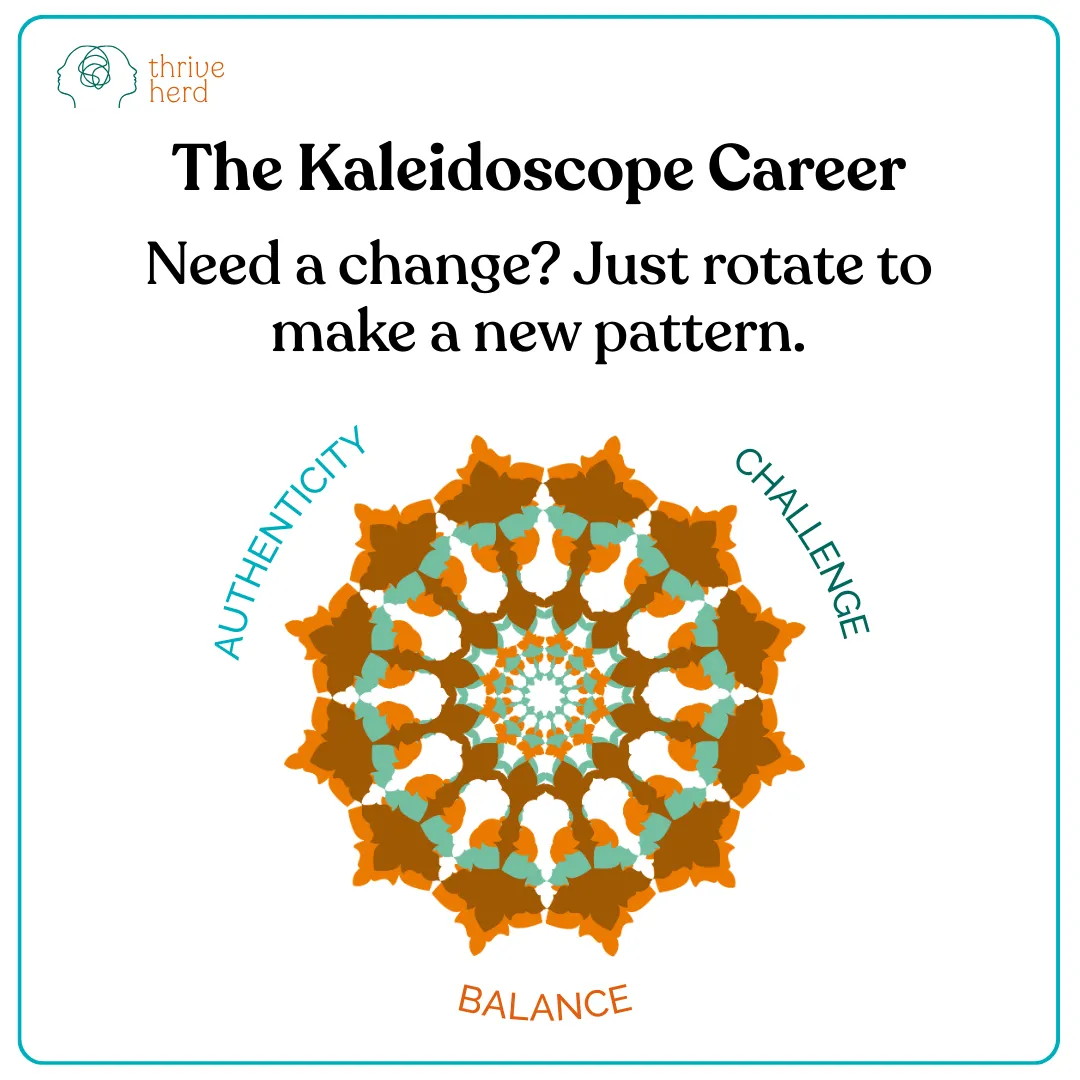
Or consider the 'kaleidoscope career,' which focuses on adjusting the three elements of Authenticity, Balance, and Challenge, where a slight turn can realign our priorities and create an entirely new, fulfilling pattern without any sense of upward or downward movement.
If you focus on continual adjustments to create the optimal picture for yourself at any given time, you’ll never be behind.
Your environment profoundly shapes your confidence. If people, places, or habits consistently cause self-doubt or negativity, strategically limit that exposure. This is essential, intentional boundary-setting, not avoidance.
Practical ideas include:
Confidence needs nourishment and an optimal atmosphere; it cannot thrive amid persistent criticism or energy-draining interactions.
Growth and change can be boosted by acting slightly ahead of how you feel.
Don't wait for the feeling of readiness; feelings often lag behind commitment.
But let’s be crystal clear: this is practising, not pretending. Pretending is a facade, while practicing is sustained, intentional effort to rewire your mind – in other words, a rehearsal for your desired future life.
For example, imagine you’re considering a move into organisational analysis but still feel like an outsider. Instead of waiting until you “feel ready”, you might volunteer to review a small internal process at work, ask sharper systems-level questions in meetings, or introduce yourself at an event as someone exploring organisational effectiveness.
This often feels uncomfortable, especially if you’re used to minimising your achievements.
But saying, “I handled that well,” or “I’m proud of that step,” builds reinforcement. We see how powerful this is when members begin sharing small wins publicly – which they’re hesitant to do, initially. The shift is gradual but real.
Overthinking creates paralysis because it magnifies uncertainty without adding evidence.
Action, even small action, creates data.
If you feel stuck, ask: “What is one behaviour that moves this forward?”
Do that first. Let the thinking catch up later.
We’ve already touched on gap-filling and upskilling being sensible expectations for a career transition.
Well, in that case, it’s important to note that confidence is behavioural. Not magical, random or personality-based – behavioural.
This means it is trainable, repeatable and improvable.
So add it to your upskilling list. It’s a gap to fill, like any other. It’s an item for your to-do list.
This is not dissimilar to visibility – i.e. being seen and understood by others – which is why many people feel stuck until they understand why they’re not getting noticed at work. Often people assume visibility is just a fact, but as we discuss in our article on the subject, it's a skill you can develop.
When you begin to see confidence this way, too, it turns into something actionable, and not a cause for shame or hesitation. It becomes practice rather than personality.
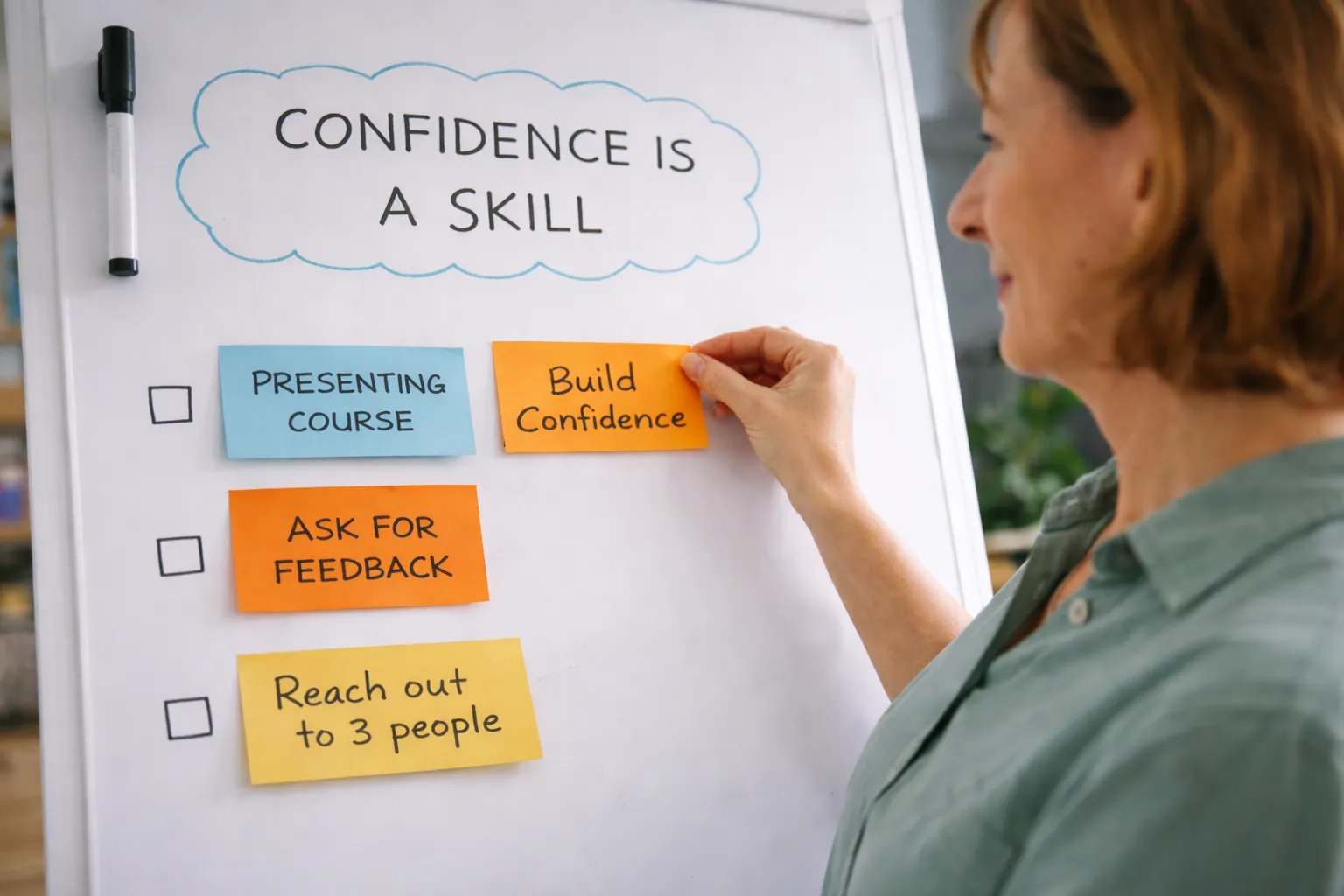
Throughout this guide, we’ve repeated a key takeaway: that thoughts alone do not update identity, build confidence or make change happen.
Experience does.
You will not wake up one morning feeling fully ready. Most people don’t. The ones who change career successfully wake up and take a step anyway.
Confidence isn’t the starting point or a pre-requisite. It’s what you earn along the way. It’s an outcome. It’s a skill.
Each small experiment, each conversation, each stretch moment becomes a brick in your new professional identity. Over time, those bricks form something solid enough to stand on.
If you’re unsure how to feel more confident while exploring, reduce the stakes rather than raising them.
We see repeatedly that confidence grows from exposure, not contemplation. The act of trying reshapes how you see yourself.
Start by rebuilding evidence quickly. Small actions, small wins and small exposure rebuild self-trust more reliably than long periods of reflection.
Confidence builds gradually. It’s cumulative. Consistency matters more than intensity. If you're navigating a professional reset and want to build confidence faster, 1-1 coaching can help clarify direction and momentum.
Absolutely. Confidence is not extroversion. It is self-trust built through preparation, practice and lived experience.
Then you gain data. Completion still counts as progress because you’ve generated evidence about fit, energy or preference.
Failure refines direction.
Borrow belief where you can, but prioritise generating your own evidence. Over time, self-trust tends to speak louder than reassurance.
You do not need to feel confident to begin.
You need to begin in order to build confidence.
Every step becomes evidence. Evidence becomes identity. Identity builds self-trust.
Reinvention is not a sign of failure. It’s a sign that you’re still paying attention to who you are becoming – and that, in itself, requires a quiet kind of courage.
If this feels familiar, you’re not the only one. Inside Thriveherd, we practise this slowly and deliberately, turning reflection into lived action and allowing confidence to grow at a human pace.
Follow us on social media:




%20(1).jpg)
.jpg)